State/Province

Midwest Cover Crops Council (MCCC-113)

University of Missouri Extension (MX82)


This publication is intended to provide a starting point for farmers who are new to growing cover crops. With experience, farmers may fine-tune the use of cover crops for their systems.

Introduction

The following recipe provides an introductory approach to integrating a cover crop into a soybean-corn rotation. Often the easiest place to begin is to plant a cover crop ahead of a soybean cash crop following corn, so consider starting with the companion recipe titled Post Corn, Going to Soybean (publication MCCC-112/MX81; see Resources). Planting cereal rye before corn is discouraged for beginning cover crop users. Experienced cover crop growers can plant it successfully, but it requires changes to nitrogen management and other adjustments.

This publication focuses on cover crops with higher success rates preceding corn, namely (1) a two-way mix of oats and radish for a combination that winterkills and, thus, does not require spring termination or (2) a two-way mix of oats and crimson clover for more erosion control plus living roots through spring. Note that crimson clover terminated in early to mid-April will contribute only minor nitrogen fixation due to limited growth. It needs to grow into about the second week of May before nitrogen contribution from the clover starts to become more substantial. But even a little N fixation is helpful because the clover normally overwinters and it can continue to provide living roots to feed the soil biology while providing a modest level of erosion prevention in combination with the oat residue.

Planning and Preparation
  • Planning—Educate yourself. Start small. Be timely. Prioritize management based on your purpose and objectives. What is your termination plan/capability? Do you have the capability to terminate a cover crop prior to planting? If so, do you want a cover crop that overwinters, providing erosion control and living roots to feed the soil biology through spring?
  • Soybean variety and planting—If possible, plant the preceding soybean crop early and use an early maturity soybean cultivar. One strategy is to use your earliest-maturity-group soybeans on the fields where you plan to seed cover crops and plant those beans first. Maturity groups to consider will vary significantly from north to south across Missouri, with the potential of some yield loss if planting a shorter maturity bean.
  • Residual soybean herbicides—Because oats are very tolerant of most soybean residual herbicides, few restrictions apply unless grazing is being considered. Radish is more sensitive and will likely be harmed if ALS-type (group 2) or PPO-type (group 14) herbicides are used in the soybean cropping season. Crimson clover will have different herbicide tolerance than radish, depending on the herbicide group used. Publications are available to provide guidance on cover crop sensitivity to selected herbicides (see Resources section).
  • Seed purchase—Order cover crop seed early. You can prepare your own two-way cover crop mixes or order pre-mixed from some sources. Named varieties can produce substantially more growth or more predictable growth and maturity, and are generally recommended. If using VNS (variety not stated) seed, be sure that it has a good germination rate (85% or higher) and is purchased from a reputable seed dealer. Note that this means the seed has been cleaned, tested for germination, and has a seed tag even though it is VNS. Though some producers have tried using feed oats as covers, this is not recommended as it often results in lower germination and unsatisfactory establishment results, and the feed oats may contain weed seed or foreign matter that can affect seeding equipment. For cover crop radishes (daikon type), be sure to purchase a single variety from a reputable seed dealer since mixed varieties may bolt or go to seed rather than producing the desired large amounts of biomass and roots. Planting date strongly influences radish root development. Be sure to buy inoculum specific to crimson clover to mix with the seed before planting; this will insure nodulation and nitrogen fixation. (Keep the inoculum stored in cool, dry conditions until use.)
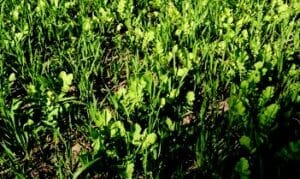
Figure 1. A growing oats/radish mix in soybean stubble (Eileen Kladivko)
Fall Work
  • Soybean harvest—Harvest fields where the cover crops are to be planted as early as possible. September weather conditions in Missouri are suitable for beans to be harvested at 16% moisture and be air-dried in the bin with proper management.
  • Timing of planting—Ideally, plant oats/radish or oats/crimson clover immediately after soybean harvest. Radish in particular needs early planting to get full benefits, so try to plant a mix of radishes and oats no later than mid-September in most of Missouri and until late September in the Bootheel. For a mix of crimson clover and oats, try to seed by the end of September in most of Missouri and by a week or two later in the Bootheel. See the Cover Crop Selector Tool (in Resources section) for more precise dates for your county.
  • Planting method—Radish and crimson clover need shallow seeding, so drill these to a depth of 0.25–0.50 inch. If broadcasting seed, note that incorporation of the seed should be light since excessive disturbance of soybean stubble may bury the seed too deep and reduce erosion prevention. See the Cover Crop Selector Tool in Resources for more details on seeding methods. Do not plant radishes as a single-species cover crop, particularly on rolling topography, or in wider (15 inch or more) rows as radishes tend to loosen the soil and provide little winter/spring residue, which can result in erosion.
  • Seeding rate in oats/radish mix—Drilled: oats, 30–60 lbs./acre; radish, 2–3 lbs./acre. Broadcast: oats, 35–70 lbs./acre; radish, 3–4 lbs./acre.
  • Seeding rate in oats/crimson clover mix—Drilled: oats, 30–60 lbs./acre; crimson clover, 8 lbs./acre. Broadcast: oats, 35–70 lbs./acre; crimson clover, 10 lbs./acre. Remember to inoculate the crimson clover to get nitrogen fixation.
  • Seeding with a grain drill—If you have a grain drill with two seed boxes, instead of premixing the two cover crop species, the oats can be put in the large seed box and the radish or clover can be put in the small seed box, allowing a specific seed rate for each. In that case, drill oats to a depth of 0.50–1.00 inch, and drill radish and crimson clover to a depth of 0.25–0.50 inch.
  • Aerial seeding or overseeding—An alternative to seeding after harvest is to do aerial seeding with a plane or helicopter or overseeding with a ground-based vehicle. In most of Missouri, seeding should take place in late August or by the first week of September and before 25% of the soybean leaves have yellowed and dropped. Rainfall after seeding is essential for establishment.
  • Seeding rate for overseeding the mix into standing soybean before harvest—For oats: 40–60 lbs./acre; for radish: 3–4 lbs./acre. If using crimson clover instead of radish, the rate would be 10 lbs./acre.
  • Fertility or liming—If applying P, K, or lime, complete the application prior to the seeding operation or apply to the growing cover crop before the ground freezes. If it is necessary to inject N fertilizer or manure in the fall, a low-disturbance applicator should be used to minimize reduction in surface residues.
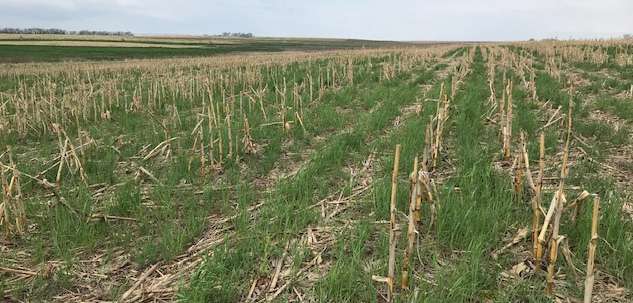
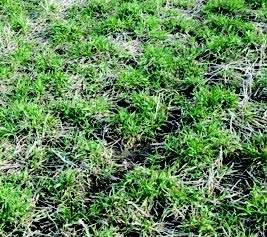
Figure 2. Residue of oats/radish mix in early March (Eileen Kladivko)
Spring Work
  • Scouting—In the spring, scout fields with crimson clover to determine if there is a viable stand providing nitrogen benefit. If a nitrogen credit is desired, corn planting may need to be delayed to continue clover growth. Oats and radish will probably have winterkilled and, thus, no termination is needed other than your usual herbicide program.
  • Termination Timing—For crimson clover, termination timing depends on whether a nitrogen credit is desired. For beginning users, target termination of the clover about two weeks prior to planting corn. With experience, termination may be delayed to increase nitrogen benefits.
  • Termination herbicide—Depending on your preferred herbicide program, multiple herbicides are available for clover termination. For more information, see the publication Evaluation of Herbicide Programs for the Termination of Cover Crop Species in the Spring in Resources.
  • Termination modifications for dry weather—Watch the weather and be ready to modify your termination plans. In a dry spring, cover crops have the potential to use moisture that the cash crop will need, so terminate cover crops sooner to allow rainfall to make up the deficit by returning the soil moisture to field capacity.
  • Termination modifications for wet weather—In a wet spring, when it has been very difficult to get into the fields to spray, be ready to take advantage of any break in the weather and/or use low axle weight sprayers or one with floater tires. Avoid termination timing that results in planting corn into a dying cover crop or a thick residue mat that prevents the soil from drying.
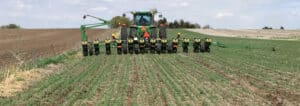
  • Corn planting—Modern corn planters are capable of planting into crimson clover residue with minimal or no modifications. Check planting depth and seed slot closure, making adjustments as needed to insure proper seed placement. Planter unit components that can affect planting performance include coulters and residue cleaners (if used), condition of disk openers, and style of closing wheels. Recheck planting depth periodically and maintain a planting speed that minimizes row unit bounce to achieve a uniform planting depth.
Resources

Post Corn, Going to Soybean: Use Cereal Rye (Missouri Cover Crops Recipe Series, MCCC-112/MX81)—available from the Midwest Cover Crops Council

Cover Crop Selector Tool —available from the Midwest Cover Crops Council

Cover Crops in Missouri: Putting Them to Work on Your Farm (University of Missouri Extension Guide G4161)

Evaluation of Herbicide Programs for the Termination of Cover Crop Species in the Spring, Division of Plant Sciences, University of Missouri

The Effects of Herbicide Carryover on Cover Crops, Division of Plant Sciences, University of Missouri

Authors

Charles Ellis and Rob Myers, University of Missouri(Note: This publication was adapted with consent from MCCC under a joint project to produce customized introductory guidance about cover crops for all member states/provinces.)

Reviewers and Contributors

Kerry Clark, University of Missouri; Eileen Kladivko, Purdue University; Greg Luce, University of Missouri; Anna Morrow, Midwest Cover Crops Council; and Tim Reinbott, University of Missouri

The Midwest Cover Crops Council (www.https://www.midwestcovercrops.org) aims to facilitate widespread adoption of cover crops throughout the Midwest by providing educational/outreach resources and programs, conducting new research, and communicating about cover crops to the public.
Funding for this project was provided by McKnight Foundation.

August 2019

The U.S. Department of Agriculture (USDA) prohibits discrimination in all its programs and activities on the basis of race, color, national origin, age, disability, and where applicable, sex, marital status, familial status, parental status, religion, sexual orientation, genetic information, political beliefs, reprisal, or because all or a part of an individual’s income is derived from any public assistance program. (Not all prohibited bases apply to all programs.) Persons with disabilities who require alternative means for communication of program information (Braille, large print, audiotape, etc.) should contact USDA’s TARGET Center at (202) 720-2600 (voice and TDD). To file a complaint of discrimination write to USDA, Director, Office of Civil Rights, 1400 Independence Avenue, S.W., Washington, D.C. 20250-9410 or call (800) 795-3272 (voice) or (202) 720-6382 (TDD). USDA is an equal opportunity provider and employer. ©2019 by MCCC. All rights reserved.

Share

Midwest Cover Crops Council (MCCC-112)

University of Missouri Extension (MX81)


This publication is intended to provide a starting point for farmers who are new to growing cover crops. With experience, farmers may fine-tune the use of cover crops for their systems.

Introduction

The following recipe provides an introductory approach to integrating a cover crop into a corn-soybean rotation. Planting a cover crop ahead of a soybean cash crop is often the easiest way to introduce cover crops into your rotation. Cereal rye has been proven to be a successful choice prior to soybean because typical fall conditions in Missouri allow for a September corn harvest, providing a suitable planting window for cereal rye.

Planning and Preparation
  • Planning—Educate yourself. Start small. Be timely. Prioritize management based on your purpose and objectives.
  • Corn hybrid and planting—If possible, plant the preceding corn crop early using your earliest maturity corn hybrid. One strategy is to use cover crops on the field you usually harvest first, on sloping ground, or on a field where you can watch it regularly, and to plant your earliest maturity hybrid on that field.
  • Residual corn herbicides—Cereal rye can be seeded and a successful stand will occur in the fall following most of the spring-applied residuals used in corn. Publications are available to provide guidance on cover crop sensitivity to selected herbicides (see Resources section). If cereal rye will be grazed or fed to livestock, there are some restrictions. Consult herbicide labels for guidance.
  • Seed purchase—Order cereal rye seed early. Named varieties can produce substantially more growth or more predictable growth and maturity, and are generally recommended. If using VNS (variety not stated) seed, be sure that it has a good germination rate (85% or higher) and is purchased from a reputable seed dealer. Note that this means the seed has been cleaned, tested for germination, and has a seed tag even though it is VNS. Bin-run seed can have lower germination, excessive foreign matter affecting planting equipment operation, and weed seed.
Fall Work
  • Corn harvest—Harvest fields where cereal rye is to be planted as early as possible. September weather conditions in Missouri are conducive to on-farm, in-bin drying, allowing for higher-moisture grain to be harvested.
  • Tillage or no-tillage—To allow for adequate cover crop growth, it is best or easier if no tillage is planned for after rye planting or before intended rye termination date. (The slight exception would be tilling strips for a strip-till system.) Cover crops work well with a no-till or strip-till system.
  • Timing of planting—Ideally, plant cereal rye as soon after corn harvest as possible. For Missouri, plant rye no later than early November in the northern half of the state and by mid-November in the southern half of the state. Earlier planting is better, including at any time in September or October, or even by overseeding into corn before harvest. Use the Cover Crop Selector Tool (in Resources section) for more precise dates for your county.
  • Seeding rate—Drilled: 50–60 lbs./acre. Broadcast with shallow incorporation: 60–70 lbs./acre. If planting in September with conducive weather conditions, broadcasting with no incorporation can be successful at the 60–70 lbs./acre seeding rate. If cereal rye is being used for grazing or if maximum erosion control is the goal, consider boosting the seeding rate by about 20% more than these recommendations. These rates are based on high-quality seed with germination rates of 85% or higher.
  • Planting method—Drill to 0.75–1.50 inches deep or broadcast with shallow incorporation. An air-seeder mounted on a vertical tillage tool can also be used. Multiple planting methods can be used, including soybean split-row planters on 15 in. spacing while reducing seeding rates to 25–30 lbs./acre. At these lower rates and wider row spacing, be aware that erosion control will be less. For the highest chance of success in establishing the cover crop, direct-seeding is preferred over broadcasting seed with no incorporation.
  • Fertility or liming—If applying P, K, or lime, complete the application prior to the seeding operation or apply to the growing rye before the ground freezes. If it is necessary to inject manure, low-disturbance injectors are available that will cause minimal damage to the cereal rye. Surface application of liquid manure on top of the rye is not recommended. Surface broadcast of dry manure or litter should be done prior to seeding, but 4 tons or less can be applied to growing cereal rye with minimal damage by using modern spreading equipment that provides even distribution.
Spring Work
  • Scouting—In the spring, scout your cereal rye cover crop to determine how well it is growing and its coverage. But if rainfall is below normal, scout also to monitor soil moisture in case earlier termination is needed.
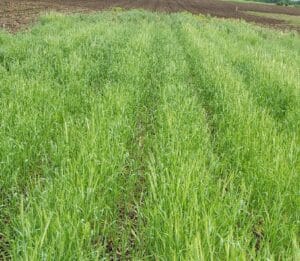
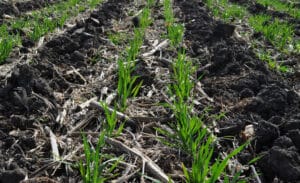
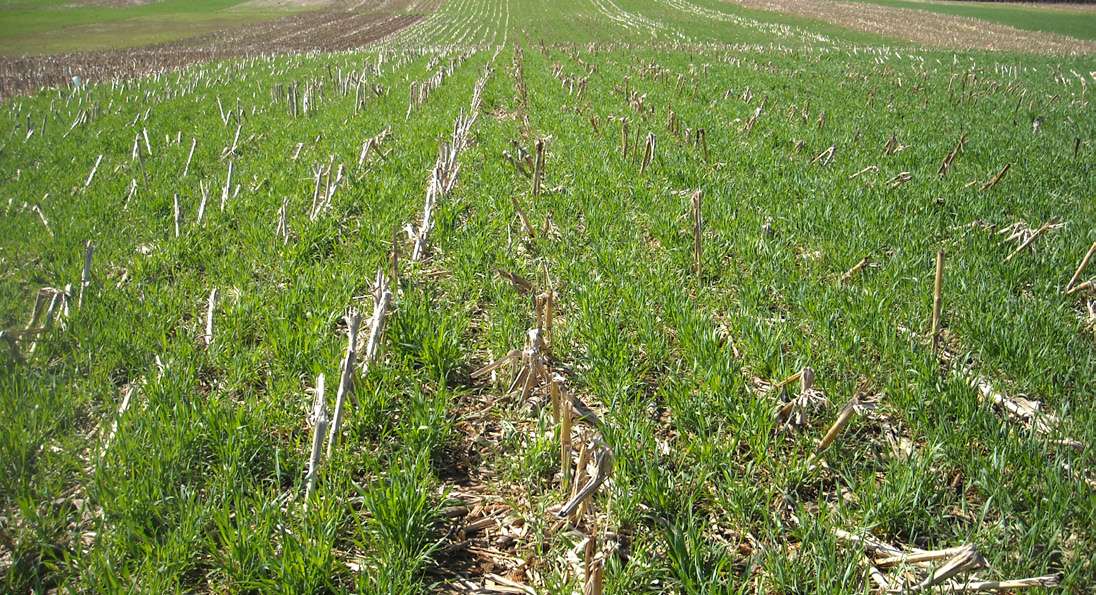
  • Termination timing—Terminate the cereal rye in the spring when plants are 6 to 12 inches tall and actively growing or about two weeks before planting soybean—whichever comes first. Many growers will successfully plant soybean into terminated cereal rye much taller than 12 inches, especially if weed control is a primary purpose, but new cover crop users should terminate when the cereal rye is smaller (see Figure 1). As a producer gains experience, termination may not happen until planting.
Figure 1: Terminate cereal rye growth when approximately 6 inches in height (shown here). (Eileen Kladivko)
Figure 1: Terminate cereal rye growth when approximately 6 inches in
height (shown here). (Eileen Kladivko)
  • Termination herbicide—Cereal rye can easily be terminated with a full rate of glyphosate (minimum of 1 lb. acid equivalent per acre) after dormancy breaks in the spring. Effectiveness and rapidity of termination improves if rye is rapidly growing and air temperatures are warmer. Larger rye, rye past the boot stage, or rye sprayed during cooler weather (below 55ºF) can be more difficult to kill or will die more slowly.
  • Termination modifications for dry weather—Watch the weather and be ready to modify your termination plans. In a dry spring, the cereal rye cover crop has the potential to use moisture that the cash crop will need, so terminate cover crops sooner to allow rainfall to make up the deficit by returning the soil moisture to field capacity.
  • Termination modifications for wet weather—In a wet spring, when it has been very difficult to get into the fields to spray, be ready to take advantage of any break in the weather and/or use low axle weight sprayers or one with floater tires. If projected soybean planting is less than 10 days away and the rye is tall, then it often works better to spray within a day or two of planting. It is usually better to plant either into brown, completely dead rye plants that were terminated early or into standing green rye plants that will be terminated shortly after bean planting. Avoid planting beans into large, dying, yellow/green (“rubbery”) cereal rye plants that have fallen on the soil surface and formed a mat; this situation is most likely to happen when rye is terminated in the window of one to two weeks before bean planting, especially in cool weather. The terminated cereal rye will limit soil drying due to no plant growth and limited sun and wind exposure.
  • Soybean planting—It is usually best to use a no-till planting approach for seeding soybean in a rye cover crop. Almost all modern planters and drills are fully capable of planting soybean into a cereal rye cover crop. Check planting depth and seed furrow closure shortly after beginning to plant into the cover crop residue as usually some adjustments are needed. Planter unit components that can affect planting performance include coulters and residue cleaners (if used), condition of disk openers, and style of closing wheels. Seed slot closure conditions may affect residual herbicide products that can be used immediately after planting. Consult herbicide labels before use.
  • Scouting—After soybean planting, scout for soybean emergence and population. Population issues can be related to planter performance, voles, and slugs. Additionally, scout for weeds since substantial cereal rye residue can often delay emergence of annual weeds, which may delay the application of post-emergence herbicides.
Resources

Cover Crop Selector Tool — available from the Midwest Cover Crops Council

Cover Crops in Missouri: Putting Them to Work on Your Farm (University of Missouri Extension Guide G4161)

Evaluation of Herbicide Programs for the Termination of Cover Crop Species in the Spring, Division of Plant Sciences, University of Missouri

The Effects of Herbicide Carryover on Cover Crops, Division of Plant Sciences, University of Missouri

Authors

Charles Ellis and Rob Myers, University of Missouri (Note: This publication was adapted with consent from MCCC under a joint project to produce customized introductory guidance about cover crops for all member states/provinces.)

Reviewers and Contributors

Kerry Clark, University of Missouri; Eileen Kladivko, Purdue University; Greg Luce, University of Missouri; and Anna Morrow, Midwest Cover Crops Council; and Tim Reinbott, University of Missouri

The Midwest Cover Crops Council (www.https://www.midwestcovercrops.org) aims to facilitate widespread adoption of cover crops throughout the Midwest by providing educational/outreach resources and programs, conducting new research, and communicating about cover crops to the public.
Funding for this project was provided by McKnight Foundation.

August 2019

The U.S. Department of Agriculture (USDA) prohibits discrimination in all its programs and activities on the basis of race, color, national origin, age, disability, and where applicable, sex, marital status, familial status, parental status, religion, sexual orientation, genetic information, political beliefs, reprisal, or because all or a part of an individual’s income is derived from any public assistance program. (Not all prohibited bases apply to all programs.) Persons with disabilities who require alternative means for communication of program information (Braille, large print, audiotape, etc.) should contact USDA’s TARGET Center at (202) 720-2600 (voice and TDD). To file a complaint of discrimination write to USDA, Director, Office of Civil Rights, 1400 Independence Avenue, S.W., Washington, D.C. 20250-9410 or call (800) 795-3272 (voice) or (202) 720-6382 (TDD). USDA is an equal opportunity provider and employer. ©2019 by MCCC. All rights reserved.
Share

Midwest Cover Crops Council (MCCC-111)

Michigan State Extension (CC-05)


This publication is intended to provide a starting point for farmers who are new to growing cover crops. With experience, farmers may fine-tune the use of cover crops for their systems.

Introduction

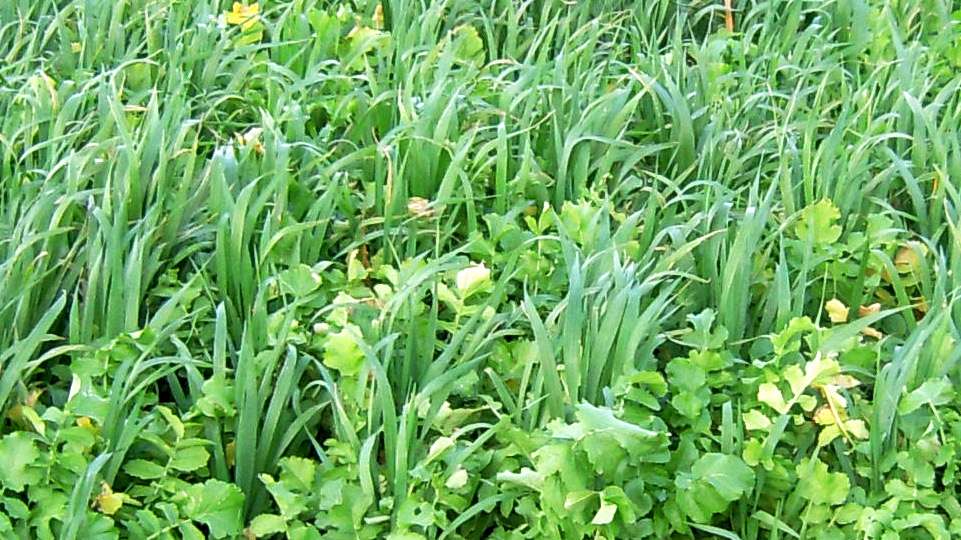
The following recipe provides an introductory approach to integrating a cover crop into a wheat rotation with soybean or corn. Planting oat and radish cover crops after wheat (see Figure 1) and ahead of a soybean or corn cash crop is an easy way to introduce cover crops into your rotation because these cover crops both winterkill and add important diversity to agricultural fields.

Figure 1. A growing oats and radish mix (Paul Gross)
Planning and Preparation
  • Planning—Educate yourself. Start small. Be timely. Prioritize management based on your purpose and objectives.
  • Wheat variety and planting—No modifications to wheat variety and planting are required for the successful use of cover crops after wheat harvest.
  • Residual wheat herbicides—Oats and radish are tolerant of most wheat residual herbicides, and few restrictions apply unless grazing is being considered. Oats and radish may be sensitive to Osprey® and PowerFlex®, and while data is limited, possible injury may result. See Weed Control Guide for Field Crops (in Resources section) for more details.
  • Seed purchase—Order cover crop seed early. Named varieties generally perform more predictably and can produce substantially more growth than variety not stated (VNS) seed but are more expensive. VNS seed may be a good option when purchased from a reputable dealer if it has been cleaned, tested for germination, and has a seed tag. For cover crop radishes (daikon type), be sure to purchase a single variety from a reputable seed dealer since mixed varieties may have unpredictable emergence or immediately flower and produce seed rather than producing the desired large amounts of biomass and roots.
Summer/Fall Work
  • Wheat harvest—Harvest wheat at the normal time in fields where a mix of oats and radish will be planted. If residue levels are high, consider removing straw or using light tillage to improve seed-to-soil contact.
  • Timing of planting—Plant oats and radish any time in August after wheat harvest. Planting a cool-season annual, such as radish, prior to August is not recommended as it may result in flowering and seed production instead of quick coverage and biomass accumulation, which is the desired goal for this cover crop. Use the Cover Crop Selector Tool (in Resources section) for precise seeding dates for your county because both proximity to the Great Lakes and latitude influence planting dates.
  • Planting method—Drill to a depth of 0.50–0.75 inch or broadcast with light incorporation. Note that disturbance of soil, if any, should be light since excessive disturbance of wheat stubble may negate any benefit of the cover crop. See Recommended Cover Crop Seeding Methods and Tools (in Resources section) for more details.
  • Seeding rate in oats/radish mix—Mix seeds prior to planting at the following rates. Drilled: oats, 30–60 lbs./acre; radish, 2–3 lbs./acre. Broadcast: oats, 35–65 lbs./acre; radish, 3–4 lbs./acre. See Cover Crop Choices Following Winter Wheat (in Resources section) for more information.
  • Tillage or no-tillage—To allow for adequate cover crop growth, it is best if no full-width tillage takes place until oats and radish have been killed by freezing temperatures. If tillage is used, it is usually better to wait until spring in order to maintain surface cover to prevent erosion.
  • Fertility or liming—If applying P, K, lime, or manure, complete the application and incorporation prior to seeding or apply to the growing oats and radish before the ground freezes. If injecting manure, low-disturbance injectors are available that will minimize damage to oats and radish. Surface application of liquid manure on top of the cover crop is not recommended. Surface broadcast of dry manure or litter should be done prior to seeding, but 4 tons or less can be applied to growing oats and radish with minimal damage provided it is evenly distributed. See the manure management publication (in Resources section) for more information on generally accepted practices for manure management and utilization.
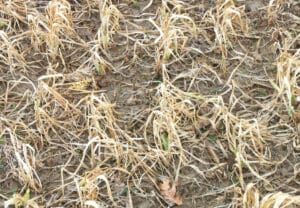
Figure 2. Residue of oats/radish mix in early March (Eileen Kladivko)
Figure 2. Residue of oats/radish mix in early March (Eileen Kladivko) 
Spring Work
  • Starter fertilizer—No modifications to your typical fertilization program are required for planting soybean or corn after oats and radish use.
  • Termination—Oats and radish should both terminate by winterkill. However, mild winters and good snow cover sometimes allow overwintering of radish. If this occurs, radish is easily terminated with typical pre-plant herbicide applications.
  • Soybean or corn planting—It is usually best to no-till plant cash crops into the dead/dry or standing cover crop. Almost all modern planters and drills are fully capable of planting soybean or corn into an oat and radish cover crop. Check planting depth and seed furrow closure shortly after beginning to plant into the cover crop residue (see Figure 2) as usually some adjustments are needed.
  • Scouting—After soybean or corn planting, scout for crop emergence and population. Additionally, scout for weeds since cover crop residue can often delay emergence of annual weeds, which may delay the application of post-emergence herbicides.
Resources

Cover Crop Selector Tool —available from Midwest Cover Crops Council

Cover Crop Choices Following Winter Wheat (Michigan State University Extension)

Weed Control Guide for Field Crops (Michigan State University Extension Bulletin E0434)

Cover Crop Termination (Michigan State University Extension publication CC-01)

Recommended Cover Crop Seeding Methods and Tools (Agronomy Technical Note)— available from USDA–Natural Resources Conservation Service

Generally Accepted Agricultural and Management Practices for Manure Management and Utilization—available from the Michigan Department of Agriculture and Rural Development

Authors

Dean Baas, Michigan State University Extension (MSUE); Christina Curell, MSUE; Paul Gross, MSUE; Monica Jean, MSUE; Philip Kaatz, MSUE; and Elizabeth H. Schultheis, MSU (Note: This publication was adapted with consent from MCCC under a joint project to produce customized introductory guidance about cover crops for all member states/provinces.)

Reviewers and Contributors

Jerry Grigar, USDA–Natural Resources Conservation Service; Erin Hill, MSU; Eileen J. Kladivko, Purdue University; Anna L. Morrow, Midwest Cover Crops Council; Sieg Snapp, MSU

The Midwest Cover Crops Council (www.https://www.midwestcovercrops.org) aims to facilitate widespread adoption of cover crops throughout the Midwest by providing educational/outreach resources and programs, conducting new research, and communicating about cover crops to the public.
Funding for this project was provided by McKnight Foundation.

August 2019

The U.S. Department of Agriculture (USDA) prohibits discrimination in all its programs and activities on the basis of race, color, national origin, age, disability, and where applicable, sex, marital status, familial status, parental status, religion, sexual orientation, genetic information, political beliefs, reprisal, or because all or a part of an individual’s income is derived from any public assistance program. (Not all prohibited bases apply to all programs.) Persons with disabilities who require alternative means for communication of program information (Braille, large print, audiotape, etc.) should contact USDA’s TARGET Center at (202) 720-2600 (voice and TDD). To file a complaint of discrimination write to USDA, Director, Office of Civil Rights, 1400 Independence Avenue, S.W., Washington, D.C. 20250-9410 or call (800) 795-3272 (voice) or (202) 720-6382 (TDD). USDA is an equal opportunity provider and employer. ©2019 by MCCC. All rights reserved.

Share

Midwest Cover Crops Council (MCCC-110)

Michigan State Extension (CC-04)


This publication is intended to provide a starting point for farmers who are new to growing cover crops. With experience, farmers may fine-tune the use of cover crops for their systems.

Introduction

This recipe provides an introductory approach to integrating a cover crop into a soybean-corn rotation. Planting a cereal rye cover crop ahead of corn is a way to introduce cover crops into your rotation. (Note: Cereal rye [Secale cereale] and annual ryegrass [Lolium multiflorum] are two different species and should not be used interchangeably.)

Planning and Preparation
  • Planning—Educate yourself. Start small. Be timely. Prioritize management based on your purpose and objectives.
  • Soybean variety and planting—If possible, plant the preceding soybean crop early and use an early maturity soybean cultivar. One strategy is to use your earliest-maturity-group soybeans on the fields where you plan to seed cover crops and plant those beans first.
  • Residual soybean herbicides—Cereal rye can be seeded and successfully established in the fall following most spring-applied residuals used in soybean. However, if cereal rye will be grazed or fed to livestock, check restrictions. See Weed Control Guide for Field Crops (in Resources section) for more details.
  • Natural Resources Conservation Service (NRCS) programs—Cover crops enrolled in the Conservation Stewardship Program (CSP) or Environmental Quality Incentives Program (EQIP) cannot be used for dual-purpose grazing.
  • Seed purchase—Order cereal rye seed early. Named varieties generally perform more predictably and can produce substantially more growth than variety not stated (VNS) seed but are more expensive. VNS seed should be purchased from a reputable dealer, be cleaned, tested for germination, and have a seed tag.
Fall Work
  • Soybean harvest—Harvest fields where cereal rye is to be planted as early as possible.
  • Tillage or no-tillage—To allow for adequate cover crop growth, it is best if no full-width tillage is planned after planting and before termination. If tillage is used, it is better to wait until spring in order to maintain surface cover to prevent erosion.
  • Timing of planting—Ideally, plant cereal rye as soon after harvest as possible and no later than one week after the 50% frost date. On average, plant before these dates: Upper Peninsula, Oct. 11; northern Lower Peninsula, Oct. 15; central Lower Peninsula, Oct. 25; and southern Lower Peninsula, Oct. 28. Use the Cover Crop Selector Tool (in Resources section) for more precise seeding dates for your county. Proximity to the Great Lakes and latitude influence these dates.
  • Planting method—Drill to 0.75–1.50 inches deep or broadcast with shallow incorporation. Good seed-soil contact will ensure a more reliable stand. See Recommended Cover Crop Seeding Methods and Tools (in Resources section).
  • Seeding rate—Drilled: 45–60 lbs./acre. Broadcast with shallow incorporation: 50–65 lbs./acre. These rates are based on high-quality seed with 85–98% germination.
  • Fertility or liming—If applying P, K, lime, or manure, complete the application and incorporation prior to seeding or apply to growing rye before the ground freezes. If injecting manure, low-disturbance injectors are available that will minimize damage to the cereal rye. Surface application of liquid manure on top of the rye is not recommended. Surface broadcast of dry manure should be done prior to seeding, but 4 tons or less can be applied to growing cereal rye with minimal damage provided it is evenly distributed.
Figure 1: Cereal rye growing after soybean (Paul Gross)
Spring Work
  • Scouting—In the spring, scout your cover crop to determine growth and coverage (see Figure 1). If rainfall is below normal, monitor soil moisture in case earlier termination is needed.
  • Termination timing—Cereal rye usually grows rapidly in the spring, so have a termination plan ready. Terminate when plants are 6 to 12 inches tall and actively growing or about two weeks before planting corn—whichever comes first. Many growers successfully plant corn into terminated cereal rye taller than 12 inches, but new users should terminate when cereal rye is smaller. See Michigan State University Extension (MSUE) publication CC-01 in the Resources section for more information.
  • Termination by herbicide—Cereal rye can easily be terminated with full-rate glyphosate (minimum of 1 lb. acid equivalent [ae]/acre) after dormancy breaks. To maximize the effectiveness of glyphosate and minimize time for complete control, apply when rye is actively growing and temperatures favor growth. Larger rye, rye past the boot stage, or rye sprayed during cooler weather can be more difficult to kill or will die more slowly. Be aware that when conditions are cool and cloudy, atrazine and saflufenacil tank mixtures with glyphosate may delay or antagonize glyphosate activity for rye termination. See MSUE Bulletin E0434 (in Resources section) for more herbicide information.
  • Termination by tillage—In systems that include tillage or are organic, tillage can be a reliable termination method. However, multiple passes may be required. See MSUE publication CC-01 (in Resources section).
  • Termination modifications for dry weather—Watch the weather and be ready to modify your plans. In a dry spring, the cereal rye can use moisture needed by the cash crop, so terminate sooner to allow rainfall to make up the deficit.
  • Termination modifications for wet weather—When using herbicides to terminate cereal rye during a wet spring and under difficult conditions for spraying, be ready to use any break in the weather and/or low axle weight sprayers. If corn planting is less than 10 days away and the rye is tall, consider planting green (i.e., terminating within a day or two of planting). It is usually better to plant either into brown, dead rye plants or into standing green plants as opposed to large, dying, yellow/green (“rubbery”) cereal rye plants that have fallen on the soil surface and formed a mat. If utilizing tillage for termination, wait 10–14 days after rye incorporation to plant corn to avoid seed predation from seed corn maggot.
  • Starter fertilizer for corn after cereal rye—Since cereal rye can tie up nitrogen, reducing its availability to corn, we recommend a 2×2 application of a starter fertilizer with a rate of 30–50 pounds of actual N per acre.
  • Corn planting—It is usually best to no-till plant corn into the dead/dry or standing cereal rye cover crop. Almost all modern planters and drills are fully capable of planting corn into a cereal rye cover crop. Check planting depth and seed furrow closure shortly after beginning to plant into residue and adjust as needed.
  • Scouting—After planting, scout for corn emergence and population. Also, scout for weeds since substantial cereal rye residue can often delay emergence of annual weeds, which may delay the application of post-emergence herbicides.
Resources

Cover Crop Selector Tool —available from Midwest Cover Crops Council

Weed Control Guide for Field Crops (Michigan State University Extension Bulletin E0434)

Cover Crop Termination (Michigan State University Extension publication CC-01)

Recommended Cover Crop Seeding Methods and Tools (Agronomy Technical Note)— available from USDA–Natural Resources Conservation Service

Authors

Dean Baas, MSUE; Christina Curell, MSUE; Paul Gross, MSUE; Monica Jean, MSUE; Philip Kaatz, MSUE; and Elizabeth H. Schultheis, MSU (Note: This publication was adapted with consent from MCCC under a joint project to produce customized introductory guidance about cover crops for all member states/provinces.)

Reviewers and Contributors

Erin Hill, MSU; Eileen J. Kladivko, Purdue University; Anna L. Morrow, Midwest Cover Crops Council; Sieg Snapp, MSU

The Midwest Cover Crops Council (www.https://www.midwestcovercrops.org) aims to facilitate widespread adoption of cover crops throughout the Midwest by providing educational/outreach resources and programs, conducting new research, and communicating about cover crops to the public.
Funding for this project was provided by McKnight Foundation.

August 2019

The U.S. Department of Agriculture (USDA) prohibits discrimination in all its programs and activities on the basis of race, color, national origin, age, disability, and where applicable, sex, marital status, familial status, parental status, religion, sexual orientation, genetic information, political beliefs, reprisal, or because all or a part of an individual’s income is derived from any public assistance program. (Not all prohibited bases apply to all programs.) Persons with disabilities who require alternative means for communication of program information (Braille, large print, audiotape, etc.) should contact USDA’s TARGET Center at (202) 720-2600 (voice and TDD). To file a complaint of discrimination write to USDA, Director, Office of Civil Rights, 1400 Independence Avenue, S.W., Washington, D.C. 20250-9410 or call (800) 795-3272 (voice) or (202) 720-6382 (TDD). USDA is an equal opportunity provider and employer. ©2019 by MCCC. All rights reserved.

Share

Midwest Cover Crops Council (MCCC-109)

Michigan State Extension (CC-03)


This publication is intended to provide a starting point for farmers who are new to growing cover crops. With experience, farmers may fine-tune the use of cover crops for their systems.

Introduction

This recipe provides an introductory approach to integrating a cover crop into a corn-soybean rotation. Planting a cereal rye cover crop ahead of soybean is a way to introduce cover crops into your rotation. (Note: Cereal rye [Secale cereale] and annual ryegrass [Lolium multiflorum] are different species and are not interchangeable.)

Planning and Preparation
  • Planning—Educate yourself. Start small. Be timely. Prioritize management based on your purpose and objectives.
  • Corn hybrid and planting—If possible, plant the preceding corn crop early and use an early maturity hybrid. One strategy is to use cover crops on the field you usually harvest first, on sloping ground, or on a field where you can watch it regularly.
  • Residual corn herbicides—Cereal rye can be seeded and successfully established in the fall following most spring-applied residuals used in corn. However, if cereal rye will be grazed or fed to livestock, check restrictions. See Weed Control Guide for Field Crops for more details.
  • Natural Resources Conservation Service (NRCS) programs—Cover crops enrolled in the Conservation Stewardship Program (CSP) or Environmental Quality Incentives Program (EQIP) cannot be used for dual-purpose grazing.
  • Seed purchase—Order cereal rye seed early. Named varieties generally perform more predictably and can produce substantially more growth than variety not stated (VNS) seed but are more expensive. VNS seed should be purchased from a reputable dealer, be cleaned, tested for germination, and have a seed tag.
Fall Work
  • Corn harvest—Harvest fields where cereal rye is to be planted as early as possible.
  • Tillage or no-tillage—To allow for adequate cover crop growth, it is best if no full-width tillage is planned after planting and before termination. If tillage is used, it is better to wait until spring in order to maintain surface cover to prevent erosion.
  • Timing of planting—Ideally, plant cereal rye as soon after harvest as possible and no later than one week after the 50% frost date. On average, plant before these dates: Upper Peninsula, Oct. 11; northern Lower Peninsula, Oct. 15; central Lower Peninsula, Oct. 25; and southern Lower Peninsula, Oct. 28. Use the Cover Crop Selector Tool for more precise seeding dates for your county. Proximity to the Great Lakes and latitude influence these dates.
  • Planting method—Drill to 0.75–1.50 inches deep or broad-cast with shallow incorporation. Good seed-soil contact will ensure a more reliable stand. See Recommended Cover Crop Seeding Methods and Tools.
  • Seeding rate—Drilled: 45–60 lbs./acre. Broadcast with shallow incorporation: 50–65 lbs./acre. These rates are based on high-quality seed with 85–98% germination.
  • Fertility or liming—If applying P, K, lime, or manure, complete the application and incorporation prior to seeding or apply to growing rye before the ground freezes. If injecting manure, low-disturbance injectors are available that will minimize damage to the cereal rye. Surface application of liquid manure on top of the rye is not recommended. Surface broadcast of dry manure should be done prior to seeding, but 4 tons or less can be applied to growing cereal rye with minimal damage provided it is evenly distributed.
Spring Work
  • Scouting—In the spring, scout your cover crop to determine growth and coverage. If rainfall is below normal, monitor soil moisture in case earlier termination is needed.
  • Termination timing—Cereal rye usually grows rapidly in the spring, so have a termination plan ready. Terminate when plants are 6 to 12 inches tall and actively growing or about two weeks before planting soybean—whichever comes first. Many growers successfully plant soybean into terminated cereal rye taller than 12 inches, but new users should terminate when cereal rye is smaller (Figure 1). See Michigan State University Extension (MSUE) publication CC-01 in the Resources section for more information.
Figure 1: Terminate cereal rye growth when approximately 6 inches in height (shown here). (Eileen Kladivko)
Figure 1: Terminate cereal rye growth when approximately 6 inches in
height (shown here). (Eileen Kladivko)
  • Termination by herbicide—Cereal rye can easily be terminated with full-rate glyphosate (minimum of 1 lb. acid equivalent [ae]/acre) after dormancy breaks. To maximize the effectiveness of glyphosate and minimize time for complete control, apply when rye is actively growing and temperatures favor growth. Larger rye, rye past the boot stage, or rye sprayed during cooler weather can be more difficult to kill or will die more slowly. Be aware that when conditions are cool and cloudy, metribuzin and saflufenacil tank mixtures with glyphosate may delay or antagonize glyphosate activity for rye termination. See MSUE Bulletin E0434 for more herbicide information.
  • Termination by tillage—In systems that include tillage or are organic, tillage can be a reliable termination method. However, multiple passes may be required. See MSUE publication CC-01.
  • Termination modifications for dry weather—Watch the weather and be ready to modify your plans. In a dry spring, the cereal rye can use moisture needed by the cash crop, so terminate sooner to allow rainfall to make up the deficit.
  • Termination modifications for wet weather—When using herbicides to terminate cereal rye during a wet spring and under difficult conditions for spraying, be ready to use any break in the weather and/or low axle weight sprayers. If soybean planting is less than 10 days away and the rye is tall, consider planting green (i.e., terminating within a day or two of planting). It is usually better to plant either into brown, dead rye plants or into standing green plants as opposed to large, dying, yellow/green (“rubbery”) cereal rye plants that have fallen on the soil surface and formed a mat. If using tillage for termination, wait 10–14 days after rye incorporation to plant soybean to avoid seed predation from seed corn maggot.
  • Soybean planting—It is usually best to no-till plant soybean into the dead/dry or standing cereal rye cover crop. Almost all modern planters and drills are fully capable of planting soybean into a cereal rye cover crop. Check planting depth and seed furrow closure shortly after beginning to plant into residue and adjust as needed.
  • Scouting—After planting, scout for soybean emergence and population. Additionally, scout for weeds since substantial cereal rye residue can often delay emergence of annual weeds, which may delay the application of post-emergence herbicides.
Resources

Cover Crop Selector Tool —available from Midwest Cover Crops Council

Weed Control Guide for Field Crops (Michigan State University Extension Bulletin E0434)

Cover Crop Termination (Michigan State University Extension publication CC-01)

Recommended Cover Crop Seeding Methods and Tools (Agronomy Technical Note)— available from USDA–Natural Resources Conservation Service,

Authors

Dean Baas, MSUE; Christina Curell, MSUE; Paul Gross, MSUE; Monica Jean, MSUE; Philip Kaatz, MSUE; and Elizabeth H. Schultheis, MSU (Note: This publication was adapted with consent from MCCC under a joint project to produce customized introductory guidance about cover crops for all member states/provinces.)

Reviewers and Contributors

Jerry Grigar, USDA–NRCS Service; Erin Hill, MSU; Eileen J. Kladivko, Purdue University; Anna L. Morrow, Midwest Cover Crops Council; Sieg Snapp, MSU

The Midwest Cover Crops Council (www.https://www.midwestcovercrops.org) aims to facilitate widespread adoption of cover crops throughout the Midwest by providing educational/outreach resources and programs, conducting new research, and communicating about cover crops to the public.
Funding for this project was provided by McKnight Foundation.

August 2019

The U.S. Department of Agriculture (USDA) prohibits discrimination in all its programs and activities on the basis of race, color, national origin, age, disability, and where applicable, sex, marital status, familial status, parental status, religion, sexual orientation, genetic information, political beliefs, reprisal, or because all or a part of an individual’s income is derived from any public assistance program. (Not all prohibited bases apply to all programs.) Persons with disabilities who require alternative means for communication of program information (Braille, large print, audiotape, etc.) should contact USDA’s TARGET Center at (202) 720-2600 (voice and TDD). To file a complaint of discrimination write to USDA, Director, Office of Civil Rights, 1400 Independence Avenue, S.W., Washington, D.C. 20250-9410 or call (800) 795-3272 (voice) or (202) 720-6382 (TDD). USDA is an equal opportunity provider and employer. ©2019 by MCCC. All rights reserved.

Share

Subscribe to our ListServ

Sign up to receive the latest MCCC news and updates!