
Barley

Midwest Cover Crops Council (MCCC-141)

Michigan State University Extension (CC-10)

This publication is intended to provide a starting point for farmers who are new to growing cover crops. With experience, farmers may fine-tune the use of cover crops for their systems.

Introduction

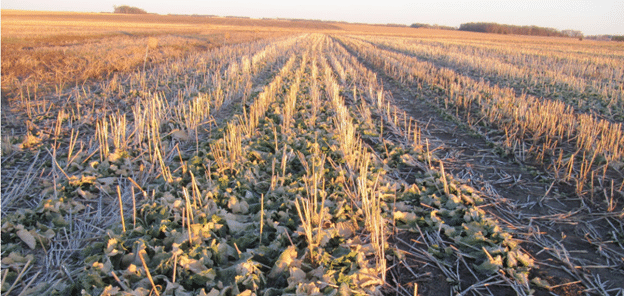
This recipe provides an introductory approach for integrating cover crops into winter canola cropping systems. A simple mix of clovers and winter cereal grains can build soil health, fx nitrogen, and prevent erosion during the fallow period between canola harvest in early summer and cash-crop planting the following spring.

Planning and Preparation
  • Winter canola variety and planting— No modifications to canola variety and planting are required for the successful use of cover crops after a canola harvest.
  • Cover crop options—Overwintering species provide fall and spring growth, and soil coverage. Overwintering clover species include crimson clover (recommended) or red clover. Overwintering cereal species include winter barley (recommended), winter wheat, triticale, or cereal rye. Note: Red clover reliably overwinters throughout Michigan; crimson clover only overwinters in the southern lower peninsula.
  • Residual canola herbicides—Clovers and winter cereals are tolerant of most canola residual herbicides, and few restrictions apply unless grazing is being considered. However, legumes such as clovers are very sensitive to clopyralid (active ingredient in Stinger®), which has long residual activity. Clovers and cereals may be sensitive to Sonalan® (ethalfuralin) and trifuralin products, and while data are limited, possible injury may result. See MSU Weed Control Guide (in Resources) for more details.
Summer and Fall Work
  • Canola harvest and field preparation— Canola harvest and field preparation—Harvest canola at the normal time in felds where cover crop(s) will be planted. If residue levels are high, consider fail mowing the remaining residue or using light tillage to improve seed-to-soil contact. If using no-till seeding, herbicides such as glyphosate, glufosinate, 2,4-D, and/or saflufenacil should be used prior to seeding to terminate weeds and volunteer canola.
  • Timing of planting— Canola harvest losses are inevitable, which leads to millions of seeds per acre on the ground that will sprout in the feld and could outcompete the cover crop. Afer the frst fush of volunteer canola has emerged and been terminated with herbicide or tillage, the cover crop can be planted. Use the MCCC Cover Crop Decision Tool (in Resources) for precise seeding dates for your county because both proximity to the Great Lakes and latitude infuence planting dates.
  • Planting method— Drill to a depth of 0.50 inches or broadcast with light incorporation. Be strategic about seeding into good soil moisture or immediately before a rain event. Note that disturbance of soil, if any, should be light since excessive disturbance of crop stubble may negate the benefts of the cover crop.
  • Seeding rate— Drilled: crimson clover, 5–6 lbs./acre; winter barley, 25–35 lbs./acre. Broadcast: crimson clover, 6–7 lbs./acre; winter barley, 30–45 lbs./acre. For best results, inoculate clover before seeding.
  • Fertility or liming— If applying phosphorus (P), potassium (K), lime, or manure, complete the application and incorporation prior to seeding or apply to the growing mixture before the ground freezes. Caution should be exercised when applying manure after cover crop planting to minimize damage to the emerging or growing cover crop.
Spring Work
  • Starter fertilizer for corn following the cover crop— Additional starter nitrogen may be necessary for corn if the barley cover crop reaches boot stage before termination.
  • Termination— Crimson clover and winter barley can be terminated in the spring by herbicide or by tillage. Winter barley and crimson clover can easily be terminated with glyphosate (0.75 lb. a.e./acre) and dicamba (0.50 a.e./acre) after dormancy breaks. To maximize the effectiveness of glyphosate and minimize time for complete control, apply when barley is actively growing and temperatures favor growth. Cereal grains past the boot stage or cereal grains sprayed during cooler weather can be more difficult to kill or will die more slowly. Additional herbicide applications may be needed to ensure termination. Be aware that when conditions are cool and cloudy, atrazine and salfufenacil tank mixtures with glyphosate may delay or antagonize glyphosate activity for barley termination. See Cover Crop Termination (in Resources) for more herbicide information.
  • Corn or soybean planting— Cash crops can be no-till planted into the dead/dry or standing cover crop. Almost all modern planters and drills are fully capable of planting corn or soybeans into this cover crop mixture. Check planting depth and seed furrow closure shortly after beginning to plant into the cover crop residue as usually some adjustments are needed.
  • Scouting—With such a small seed, canola seed loss during harvest is likely in the fall, and managing volunteer canola in the following crop is almost inevitable. Planting non-GMO canola can help keep glyphosate and glufosinate as options for controlling volunteer canola in the spring. Afer soybean or corn planting, scout for crop emergence and population. Additionally, scout for weeds since cover crop residue can often delay the emergence of annual weeds, which may delay the application of postemergence herbicides.
Resources

MSU Weed Control Guide for Field Crops (Michigan State University Department of Plant, Soil, and Microbial Sciences), www.canr.msu.edu/weeds/2026-msu-weed-control-guide
Midwest Cover Crops Council Cover Crop Decision Tool, covercroptool.midwestcovercrops.org/
Generally Accepted Agricultural and Management Practices (GAAMPs) for Manure Management and Utilization (2026; Michigan Commission of Agriculture and Rural Development), www.michigan.gov/mdard/-/media/Project/Websites/mdard/documents/environment/rtf/2026GAAMPs/2026-MANURE-MANAGEMENT-ANDUTILIZATION-GAAMPs.pdf

Cover Crop Termination (2024; Michigan State University Extension, Department of Plant, Soil, and Microbial Sciences),
www.canr.msu.edu/resources/cover-crop-termination

Authors

Madelyn Celovsky, Christine Charles, and Monica Jean, Michigan State University Extension; Brook Wilke, Michigan State University (Note: This publication was adapted with consent from MCCC under a joint project to produce customized introductory guidance about cover crops for all member states/provinces.)

Reviewers

Christina Curell, Michigan State University Extension, and Abigail Smith, USDA Natural Resources Conservation Service–Michigan.

The Midwest Cover Crops Council (www.midwestcovercrops.org) aims to facilitate widespread adoption of cover crops throughout the Midwest by providing educational/outreach resources and programs, conducting new research, and communicating about cover crops to the public.

The U.S. Department of Agriculture (USDA) prohibits discrimination in all its programs and activities on the basis of race, color, national origin, age, disability, and where applicable, sex, marital status, familial status, parental status, religion, political beliefs, reprisal, or because all or part of an individual’s income is derived from any public assistance. (Not all prohibited bases apply to all programs.) Persons with disabilities who require alternative means for communication of program information (Braille, large print, audiotape, etc.) should contact USDA’s TARGET Center at 202-720-2600 (voice and TDD). To fle a complaint of discrimination, write to USDA, Director, Ofce of Civil Rights, 1400 Independence Avenue, S.W., Washington, D.C. 20250-9410 or call 800-795-3272 (voice) or 202-720-6382 (TDD). USDA is an equal opportunity provider, employer, and lender. ©2026 by MCCC . All rights reserved.
This material is based upon work that is supported by the National Institute of Food and Agriculture, U.S. Department of Agriculture, under agreement number 2023-38640-39573 through the North Central Region SARE program under project number ENC23-226. Any opinions, fndings, conclusions, or recommendations expressed in this publication are those of the author(s) and should not be construed to represent any ofcial USDA or U.S. Government determination or policy. ©2026 by MCCC . All rights reserved.

September 2026

The U.S. Department of Agriculture (USDA) prohibits discrimination in all its programs and activities on the basis of race, color, national origin, age, disability, and where applicable, sex, marital status, familial status, parental status, religion, sexual orientation, genetic information, political beliefs, reprisal, or because all or a part of an individual’s income is derived from any public assistance program. (Not all prohibited bases apply to all programs.) Persons with disabilities who require alternative means for communication of program information (Braille, large print, audiotape, etc.) should contact USDA’s TARGET Center at (202) 720-2600 (voice and TDD). To file a complaint of discrimination write to USDA, Director, Office of Civil Rights, 1400 Independence Avenue, S.W., Washington, D.C. 20250-9410 or call (800) 795-3272 (voice) or (202) 720-6382 (TDD). USDA is an equal opportunity provider and employer. ©2022 by MCCC. All rights reserved.
Share

Midwest Cover Crops Council (MCCC-135)

This publication is intended to provide a starting point for farmers who are new to growing cover crops. With experience, farmers may fine-tune the use of cover crops for their systems.

Introduction

The following recipe provides an introductory approach to integrating a cover crop into a wheat-based rotation with soybean or corn. Planting a cover crop blend that predominantly consists of cool-season species and is winter-killed adds diversity and provides soil armor through summer and spring. However, in some situations added ground cover in the spring in combination with excess soil moisture could be a problem unless winter cereals (winter rye, wheat, or triticale) are included in the mix.

Planning and Preparation
  • Planning—Consult with university Extension staff, local NRCS staff, and experienced producers to gain insight on the practice. Start small while exploring new practices. In South Dakota, timeliness is important due to the shorter growing window. Always focus on your objectives, such as whether you are growing the cover crop for ground cover, fall grazing, nutrient cycling, etc.
  • Small-grain variety and planting—Small-grain varieties such as wheat or oats do not need to be changed or modified to incorporate cover crops following grain harvest or haying. Planting small grains early in the spring is important for good growth and development, which also typically results in earlier harvest and allows more time for cover crops to grow before a frost.
  • Residual herbicides—A blend consisting primarily of cool-season cover crops such as cereal grains (oat, barley), brassicas (radish, turnip, rapeseed), and legumes (field pea), and some warm-season grasses such as millet and sorghum-sudangrass have shown good tolerance to commonly used herbicides. If the cover crop is intended for grazing in the fall/winter, it is critical to follow grazing restrictions stated on the herbicide label.
  • Seed source—Planning ahead and ordering seed early with the objective in mind is important. Most cover crop seed dealers have their own pre-mixed blends but are willing to custom-mix upon request. Follow the seed label and review the individual species to make sure that the growth habit of each is ideal for the planting time. If opting for a mix of only one or two species, labeled varieties usually perform better than variety not stated (VNS) seeds.
Summer/Fall Work
  • Harvest—Harvest wheat/oats at the normal time. If weed pressure is high, you can spray glyphosate or other herbicides with the least residual effects. Herbicides are a better option than tillage as stirring the soil can dry it out and reduce germination. Baling small-grain residue is common in South Dakota but can make establishment of the cover crop difficult where the windrows were present.
  • Timing of planting—In South Dakota, wheat and/or oats are generally harvested from the second week of July to the first week of August. Planting cover crops immediately following harvest is recommended so that the seasonal window can be maximized. A mix consisting mostly of cool-season annual species grows well as temperatures start to gradually decrease. Use the Cover Crop Selector Tool (in Resources section) for precise seeding dates.
  • Planting method—Determining seeding depth is tricky when planting a mix with various seed sizes. Drilling to a moderate depth of 0.50–0.75 inch will be good for most mixes. Tilling or soil disturbance is not recommended as this may cause unwanted weed growth.
  • Cover crop types—Diversity of species in a mix is good and typically will provide the best benefits. The general rule of thumb is to select cover crops that are of contrasting growth habit to the subsequent cash crop. For example, if the next season’s cash crop is corn, planting cover crop blends that have a higher proportion of cool-season broadleaves is suggested; if the next season’s crop is soybean, then a mix with more cool-season grasses would be ideal. If wheat or other small grains are to be raised for seed purposes, cover crop blends that contain winter cereals (e.g., winter wheat, winter rye, winter triticale) are not suggested.
  • Seeding rate—Seed size and proportion in the mix determines the seeding rates. For example, a mix high in large-seed species such as peas and oats can be higher than the ones dominant in brassicas. Typically, the seeding rate of commonly marketed cover crop mixes can range from 15 to 30 lbs./acre. The full seeding rate of individual species can be found in Cover Crop: Common Species and Properties of South Dakota (see Resources).
  • Tillage—Tillage or soil disturbance is not suggested.
  • Fertility—Fertilizer is not usually required for a cover crop mix with well-balanced species. However, producers who have livestock and intend to maximize growth for fall/winter grazing have shown interest in using low rates of fertilizer. Although there are no specific guidelines on fertilizer rates for various cover crop blends, using nitrogen rates in the range of 30–40 lbs. N/acre can enhance cover crop growth and establishment, especially following high-yielding wheat crops.
  • Grazing—Producers who prefer to grow cover crops after small grains for grazing in the fall/winter can slightly increase the proportion of cool-season grass species such as oats and barley. Include at least 60% grasses in the mix for grazing. To assist in calculating the amount of grazing your cover crop can offer, refer to the Grazing Cover Crop Calculation App (in Resources).
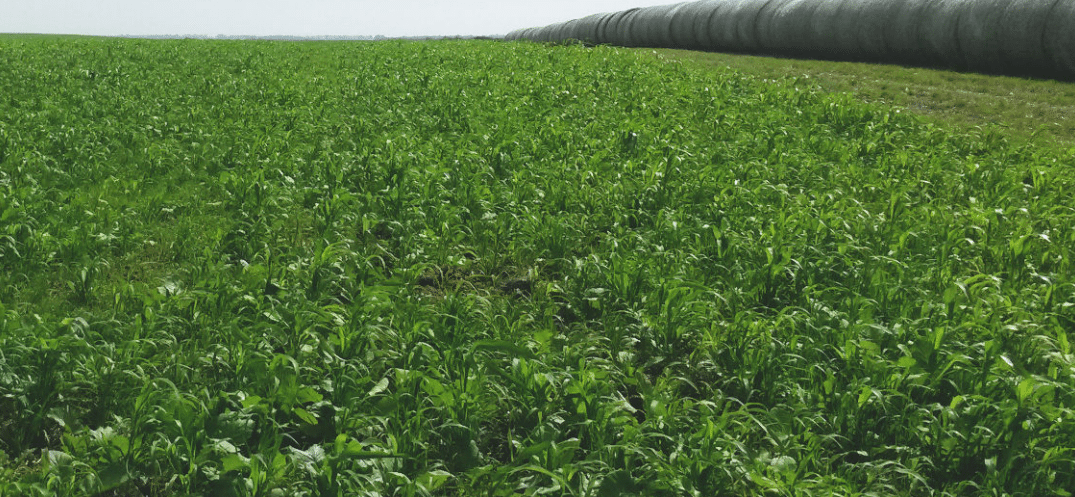
Figure 1: Frost-killed cover crops seeded after oats in southeast South Dakota (Peter Sexton)
Spring Work
  • Starter fertilizer—No modifications to your typical fertilization program are required for planting soybean or corn. However, there are a few considerations for planting corn. After a cover crop has winter-killed, get a current soil test to look at nitrates and sulfur. Cover crops can sequester nitrogen, which is a desired attribute to reduce leaching or runoff. But mixes with a high proportion of Brassica species (radish, turnip, rapeseed) can use quite a bit of sulfur. Soil-testing and applying these nutrients as needed to minimize the chance of nutrient deficiency is a good practice.
  • Termination—Typical cover crop blends should winter-kill in South Dakota. However, mild winters can leave a few plants the next spring. Timely scouting and herbicide application as needed is suggested for uniform control of cover crop plants that survived the winter. Some mixes with winter annuals such as winter triticale, cereal rye, or winter camelina will require spring termination.
  • Soybean or corn planting—It is usually best to no-till plant cash crops into the dead/dry or standing cover crop. Almost all modern planters and drills are fully capable of planting soybean or corn into terminated cover crop residue. Check planting depth and seed furrow closure shortly after beginning.
  • Scouting—After planting soybean or corn, scout for crop emergence and population. Additionally, scout for weeds since cover crop residue can often delay emergence of annual weeds, which may delay the application of post-emergence herbicides.
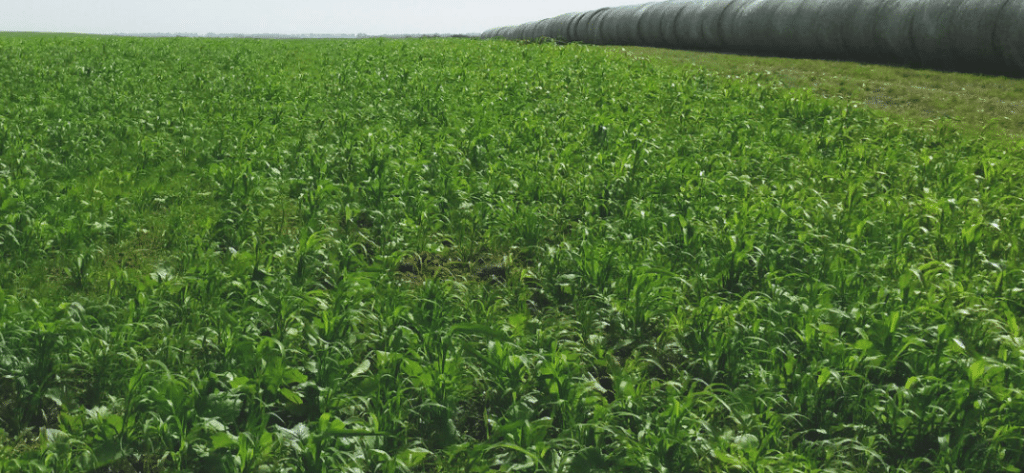
Figure 2: This photo shows cover crop growth mid-September in Lake County, SD. The field was seeded after cereal rye was hayed in June (David Karki)
Resources

Cover Crop Selector Tool—available from the Midwest Cover Crops Council, www.midwestcovercrops.org

Cover Crop Species Selection for Grazing (USDA-NRCS publication SD-FS-56)

Herbicide Residual Effects on Cover Crops after Wheat (South Dakota State University Extension)

Cover Crop: Common Species and Properties of South Dakota (USDA-NRCS)

Grazing Cover Crop Calculation App (Jotform app)

Author

David Karki, South Dakota State University Extension (Note: This publication was adapted with consent from MCCC under a joint project to produce customized introductory guidance about cover crops for all member states/provinces.)

Reviewers and Contributors

Eric Barsness, USDA-NRCS; Anthony Bly, South Dakota State University Extension; Eileen Kladivko, Purdue University; Anna Morrow, Midwest Cover Crops Council

The Midwest Cover Crops Council (www.midwestcovercrops.org) aims to facilitate widespread adoption of cover crops throughout the Midwest by providing educational/outreach resources and programs, conducting new research, and communicating about cover crops to the public.

Funding for this project was provided by McKnight Foundation.

December 2022

The U.S. Department of Agriculture (USDA) prohibits discrimination in all its programs and activities on the basis of race, color, national origin, age, disability, and where applicable, sex, marital status, familial status, parental status, religion, sexual orientation, genetic information, political beliefs, reprisal, or because all or a part of an individual’s income is derived from any public assistance program. (Not all prohibited bases apply to all programs.) Persons with disabilities who require alternative means for communication of program information (Braille, large print, audiotape, etc.) should contact USDA’s TARGET Center at (202) 720-2600 (voice and TDD). To file a complaint of discrimination write to USDA, Director, Office of Civil Rights, 1400 Independence Avenue, S.W., Washington, D.C. 20250-9410 or call (800) 795-3272 (voice) or (202) 720-6382 (TDD). USDA is an equal opportunity provider and employer. ©2022 by MCCC. All rights reserved.
Share

Subscribe to our ListServ

Sign up to receive the latest MCCC news and updates!