This publication is intended to provide a starting point for farmers who are new to growing cover crops. With experience, farmers may fine-tune the use of cover crops for their systems.
Introduction
The following recipe provides an introductory approach to integrating a cover crop ahead of corn. Planting cover crops prior to corn requires a different set of management considerations than planting them prior to soybean.
Planning and Preparation
Planning—Educate yourself. Start small. Be timely. Prioritize management based on your purpose and objectives. Visit https://www.midwestcovercrops.org for many helpful resources.
Soybean variety and planting—If possible, plant the preceding soybean crop early and use an early maturity soybean cultivar. One strategy is to use your earliest-maturity-group soybeans on the fields where you plan to seed cover crops and plant those beans first.
Residual soybean herbicides—Because oats are very tolerant of most soybean residual herbicides, few restrictions apply unless grazing is being considered. Radish is more sensitive and will likely be harmed if ALS-type (group 2) or PPO-type (group 14) herbicides are used in the soybean cropping season. (See Resources.)
Seed purchase—Order cover crop seed early. Named oat varieties grow well but are more expensive than VNS (variety not stated) seed. Work with a reputable seed dealer and choose high-quality seed that has been cleaned, tested for germination and weed seed contamination, and ideally has a seed tag. Although usually more expensive than oat seed, spring barley can be used. For cover crop radishes (daikon type), be sure to purchase a single variety from a reputable seed dealer since mixed varieties may bolt or go to seed rather than producing the desired large amounts of biomass and roots. (Note: Oats/radish alone will winterkill, so this recipe is intended to be a simple option for those interested in beginning with cover crops. But non-winterkill options, such as planting triticale or winter barley, can be incorporated. Remember that this will add an extra level of management, though, because you would have to terminate those cover crops in the spring.)
Fall Work
Soybean harvest—Harvest fields where a mix of spring oats/radish are to be planted as early as possible.
Timing of planting—Ideally, plant oats/radish immediately after harvest. In most of Illinois, this should occur by mid-September. See Selector Tool (in Resources section) for more precise dates for your county.
Planting method—Drill to a depth of 0.25–0.50 inch or broadcast, but note that incorporation of the seed, if any, should be light since excessive disturbance of soybean stubble may reduce any erosion benefit of the cover crop. See Resources for more details on seeding methods.
Aerial seeding or overseeding—An alternative to seeding after harvest is to do aerial seeding with a plane or helicopter or overseeding with a ground-based vehicle before harvest. In most of Illinois, seeding should take place in late August or by the first week of September and before 25% of the soybean leaves have yellowed and dropped. Rainfall after seeding is essential for establishment.
Seeding rate for overseeding—For oats: 40–60 lbs./acre; for radish: 2–4 lbs./acre.
Tillage, fertility, or liming—To allow for adequate cover crop growth, it is best if no full-width tillage takes place after seeding and before killing frost. If applying N, P, K, or lime, complete the application prior to the seeding operation or apply to the growing oats/radish before the ground freezes. On fields that are not highly erodible (slope 0–2%), fall strip-tillage is a viable option to apply fertility and reduce the potential effect of a cold and wet spring under moderate to heavy residue. If it is necessary to inject N fertilizer or manure in the fall, a low-disturbance applicator should be used to minimize reduction in surface residues. Any nitrogen added in the fall should include an inhibitor and should not be applied until the soil temperature is below 50°F.
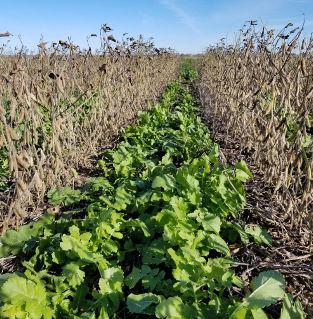
Figure 1. A growing oats/radish mix in soybean stubble (Eileen Kladivko)
Spring Work
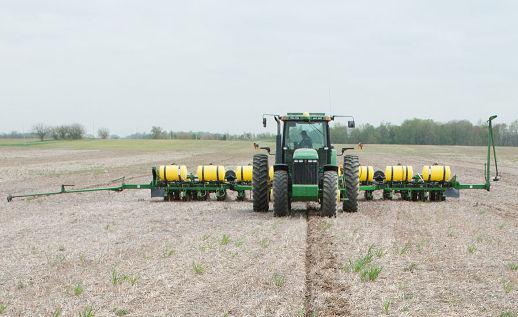
Starter fertilizer—Strongly consider equipping your corn planter with 2×2 starter fertilizer or making a broadcast N application near planting, aiming for a fertilizer rate of 30–50 pounds of actual N per acre. A preplant anhydrous ammonia application is also a viable option, but a delay in N utilization may occur until the corn grows roots toward the knife tracks. Use the Corn Nitrogen Rate Calculator determine the total amount of N you should apply for an optimal return on investment.
Strip-tillage— In high residue environments on fields that are not highly erodible, spring strip-tillage is an option to avoid the agronomic impacts of a cold and wet spring on corn production.
Jennifer Woodyard, University of Illinois Extension; Nathan Johanning, University of Illinois Extension; Shalamar Armstrong, Purdue University (Note: This publication was adapted with consent from MCCC under a joint project to produce customized introductory guidance about cover crops for all member states/provinces.)
Reviewers and Contributors
Marisol Berti, North Dakota State University; Pete Fandel, Illinois Central College; Lowell Gentry, University of Illinois; Tom Kaspar, USDA–Agricultural Research Service (retired); Eileen Kladivko, Purdue University; Anna Morrow, Midwest Cover Crops Council; Dean Oswald, Midwest Grass and Forage; and Kris Reynolds, American Farmland Trust
The Midwest Cover Crops Council (www.https://www.midwestcovercrops.org) aims to facilitate widespread adoption of cover crops throughout the Midwest by providing educational/outreach resources and programs, conducting new research, and communicating about cover crops to the public.
Funding for this project was provided by McKnight Foundation.