Source link here.

Midwest Cover Crops Council (MCCC-126)
This publication is intended to provide a starting point for farmers who are new to growing cover crops. With experience, farmers may fine-tune the use of cover crops for their systems.
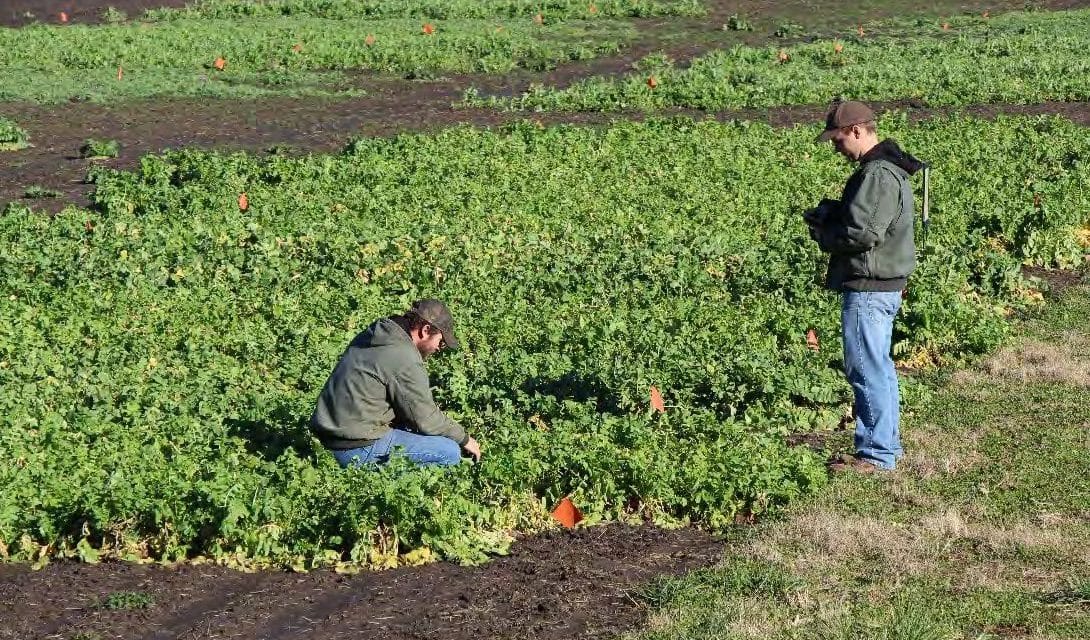
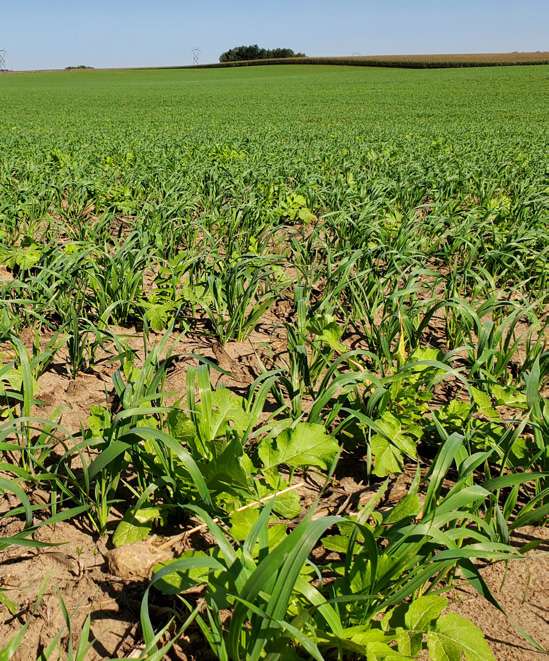
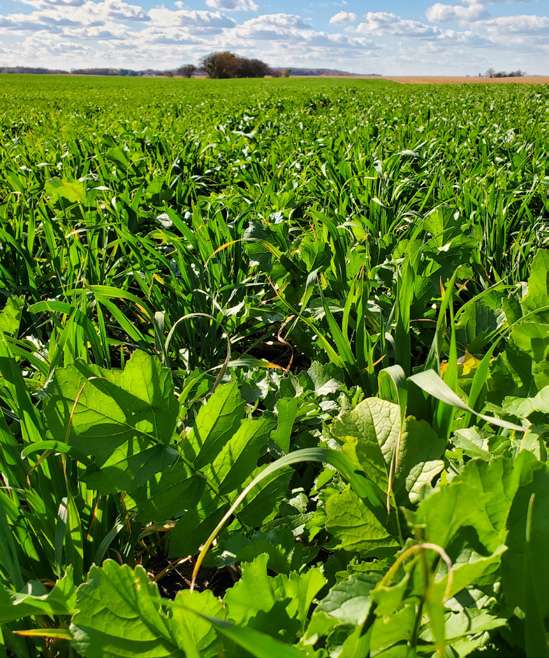
A canning or processing crop such as green bean, sweet corn, or pea is harvested early or by midsummer and offers an excellent window to get adequate cover crop growth before any following crop. Cover crops following canning crops will protect soil from erosion and improve soil structure after heavy harvesting equipment is used to take off the canning crop. Some canning crops leave significant residual nitrogen (N) in the soil that is vulnerable to leaching, and a cover crop can retain that soil N for future crops. Since growers follow canning crops with any number of different rotations, a fast-growing species such as oats mixed with a light seeding of radish is a safe choice as both will winter-kill. With this combination, no spring termination is needed, and there is little chance of tying up N for the following year.
University of Minnesota Extension Cover Crop website
Cover Crop Selector Tool —available from Midwest Cover Crops Council
Minnesota NRCS Resources, including Minnesota Cover Crop Design Tool
USDA-NRCS Cover Crop Termination Guidelines
Using Herbicides and Cover Crops in Corn and Soybean (University of Minnesota Extension)
Anna Cates, University of Minnesota Extension; Ashley Gallagher, Dakota Soil and Water Conservation District (Minnesota); Steve Lawler, Mower Soil and Water Conservation District (Minnesota); and Matt Ruark, University of Wisconsin–Madison Division of Extension
Carl Rosen, University of Minnesota; Ken Schroeder and Dan Smith, University of Wisconsin–Madison Division of Extension; and Carissa Spencer, Minnesota NRCS
March 2021
The U.S. Department of Agriculture (USDA) prohibits discrimination in all its programs and activities on the basis of race, color, national origin, age, disability, and where applicable, sex, marital status, familial status, parental status, religion, sexual orientation, genetic information, political beliefs, reprisal, or because all or a part of an individual’s income is derived from any public assistance program. (Not all prohibited bases apply to all programs.) Persons with disabilities who require alternative means for communication of program information (Braille, large print, audiotape, etc.) should contact USDA’s TARGET Center at (202) 720-2600 (voice and TDD). To file a complaint of discrimination write to USDA, Director, Office of Civil Rights, 1400 Independence Avenue, S.W., Washington, D.C. 20250-9410 or call (800) 795-3272 (voice) or (202) 720-6382 (TDD). USDA is an equal opportunity provider and employer. ©2021 by MCCC. All rights reserved.
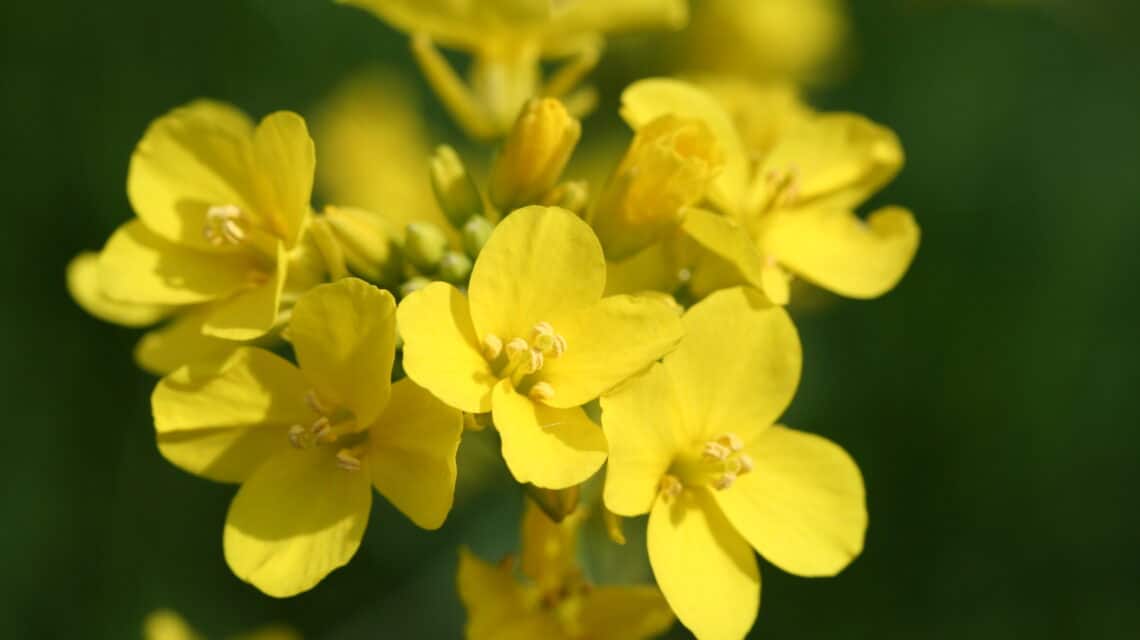
Eric Lee-Mader, Anne Stine, Jarrod Fowler, Jennifer Hopwood and Mace Vaughanby – Xerces Society for Invertebrate Conservation with contributions from the USDA Natural Resources Conservation Service
August 2017
Kim Cassida and Phil Kaatz – Michigan State University Extension
November 2019
Recommended Hay and Pasture Forages For Michigan
Source link here.
Kim Cassida and Joe Paling – Michigan State University Extension
February 2020
2019 MSU Cover Crop Variety Test Report
Source link here.
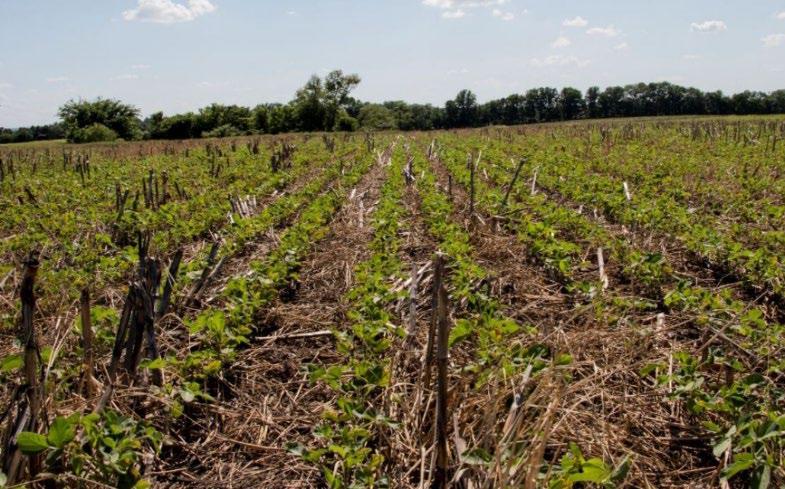
University of Wisconsin, Nutrient and Pest Management Program
Cover Crop Termination Options
Source link here.
Daniel Smith, Matt Ruark, Shawn Conley – University of Wisconsin-Madison and University of Wisconsin Extension
August 2017
Herbicide Considerations for Cover Crop Establishment
Source link here.
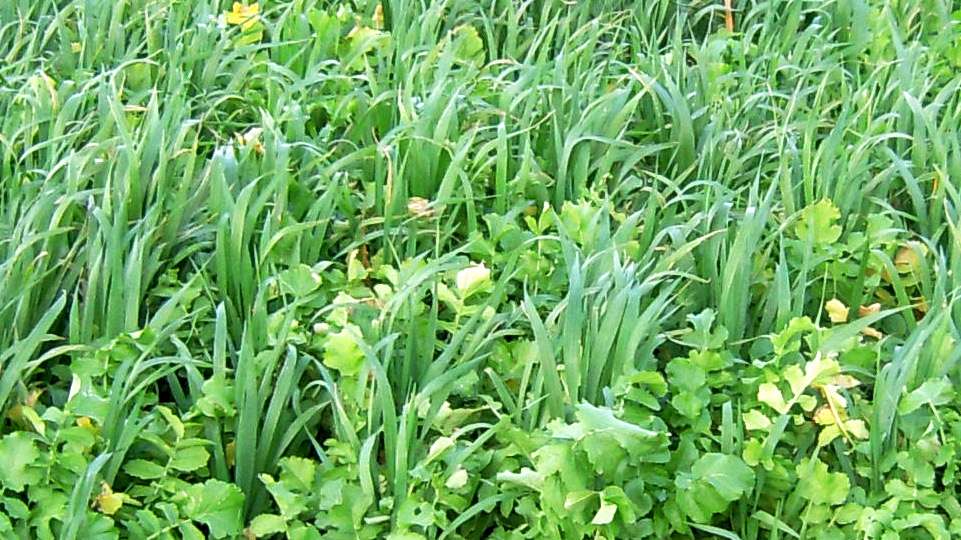
Midwest Cover Crops Council (MCCC-117)
This publication is intended to provide a starting point for farmers who are new to growing cover crops. With experience, farmers may fine-tune the use of cover crops for their systems.
The following recipe provides an introductory approach to integrating a cover crop into a soybean-corn rotation. Often the easiest place to begin is to plant a cover crop ahead of a soybean cash crop following corn, so consider starting with the companion recipe titled Post Corn, Going to Soybean (publication MCCC-116; see Resources).
Pure live seed (PLS) indicates the amount of seed in the container that is capable of developing into seedlings. To calculate PLS, the percentage of pure seed listed on the seed label of a cultivar is multiplied by the percent germination (also listed on the seed label). For example: 90% pure seed of the cultivar x 80% germination = 72% PLS.
To determine how much seed to plant, divide 100 by the percentage PLS (72 in this example): 100 ÷ 72 = 1.4. Therefore, 1.4 pounds of seed with a purity of 90% and a germination of 80% would be needed for each pound specified in the desired seed mixture.
Post Corn, Going to Soybean: Use Cereal Rye (Ohio Cover Crop Recipe series, MCCC-116)
Herbicide Rotation Restrictions in Forage and Cover Cropping Systems (University of Wisconsin Extension publication)
Calculating the Price of Pure Live Seed (PennState Extension website)
Cover Crop Selector Tool —available from Midwest Cover Crops Council
Using Cover Crops to Convert to No-till (Ohio State University Extension Fact Sheet SAG-11)
Understanding Soil Microbes and Nutrient Recycling (Ohio State University Extension Fact Sheet SAG-16)
Sarah Noggle, Ohio State University Extension; and James J. Hoorman, Hoorman Soil Health Services (Note: This publication was adapted with consent from MCCC under a joint project to produce customized introductory guidance about cover crops for all member states/provinces.)
Jason Hartschuh, Ohio State University Extension; Eileen Kladivko, Purdue University; Anna Morrow, Midwest Cover Crops Council; Eric Richer, Ohio State University Extension; Alan Sundermeier, Ohio State University Extension
January 2020
The U.S. Department of Agriculture (USDA) prohibits discrimination in all its programs and activities on the basis of race, color, national origin, age, disability, and where applicable, sex, marital status, familial status, parental status, religion, sexual orientation, genetic information, political beliefs, reprisal, or because all or a part of an individual’s income is derived from any public assistance program. (Not all prohibited bases apply to all programs.) Persons with disabilities who require alternative means for communication of program information (Braille, large print, audiotape, etc.) should contact USDA’s TARGET Center at (202) 720-2600 (voice and TDD). To file a complaint of discrimination write to USDA, Director, Office of Civil Rights, 1400 Independence Avenue, S.W., Washington, D.C. 20250-9410 or call (800) 795-3272 (voice) or (202) 720-6382 (TDD). USDA is an equal opportunity provider and employer. ©2020 by MCCC. All rights reserved.