This guide offers a starting point for farmers new to cover crops, with adjustments possible as experience grows. View the pdf here.
Introduction
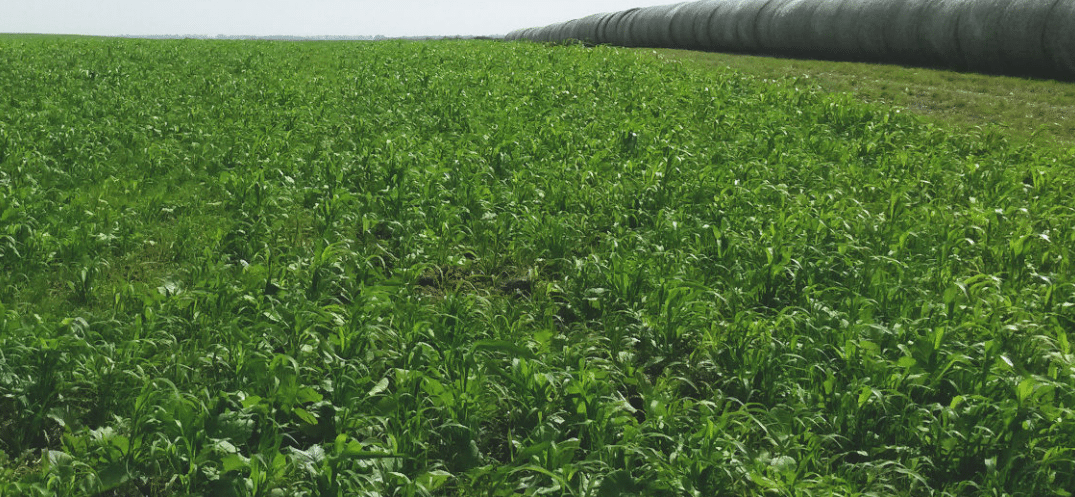
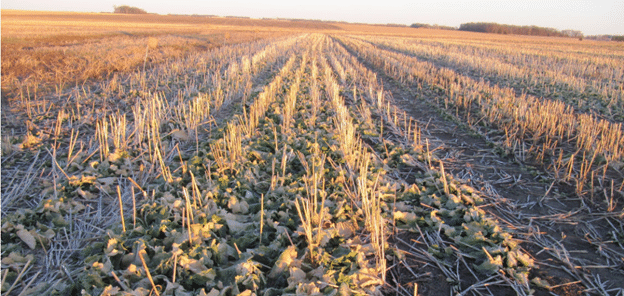
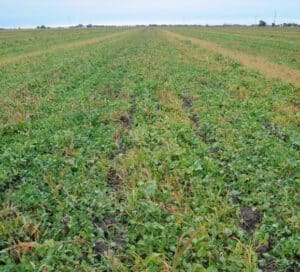
Spring small grains harvested in late summer provide a wide window to establish a strong cover crop stand, making this a low-risk introductory option. Planting a legume cover crop can provide a potential nitrogen credit for next year’s corn, depending on biomass and mineralization, while also suppressing weeds through competition and contributing to lower disease pressure through increased crop diversity. This approach builds on historical systems where legumes such as clover served as nurse crops or fertility-building phases prior to the development of synthetic fertilizers, improving soil productivity through biological nitrogen fxation. To maximize benefts, legumes are ofen underseeded with a spring small grain or frost-seeded into a winter grain. Medium red clover is a common choice because it generally does not interfere with harvest or reduce grain yield, though harvest can be challenging in warm, wet conditions. In drier parts of Minnesota, other small-seeded legumes such as alfalfa, alsike clover, or yellow blossom sweet clover may be more reliable. Local seed dealers can help guide species selection.
Planning and Preparation
• Planning—Educate yourself. Attend feld days, learn from experienced farmers, check out University of Minnesota (UMN) Extension cover crop research (see
link in Resources), and work with your local Natural Resources Conservation Service (NRCS) and Soil and Water Conservation District (SWCD) if you plan on accessing cost-share programs. Start small and select a feld with low weed pressure. Check with your crop insurance agent and the USDA-Risk Management Agency Cover Crops website (see link in Resources) to ensure your plans will not afect your coverage.
• Herbicide program—When weeds are present, a fall burndown before seeding small grains is recommended since postemergence options are extremely limited. Refer to regional weed control guides (e.g., the most recent North Dakota Weed Control Guide; see Resources section) and herbicide labels for rotational restrictions. If the clover cover will be grazed or used for feed, follow all label rotational requirements. Some herbicides can persist at levels that might injure rotational crops into the next cropping seasons; therefore, review the recent herbicide history before planting. (See Managing Risk When Using Herbicides and Cover Crops in Corn and Soybean in Resources.)
• Seed purchase—Order cover crop seed early from a reputable source, ensuring it is cleaned and tested for germination and weed seed contamination. Named varieties are selected for specifc traits such as vigor or winter survival and tend to perform more predictably, though they usually cost more than VNS (variety not stated) seed. To reduce risk, avoid seeds of unknown origin and quality. Ensure the seed is inoculated with the proper red clover inoculant for efective nitrogen fxation.
Spring Work Preceding Cover Crop
• Equipment and seeding considerations—Take stock of available equipment to determine how and when red clover will be seeded with the small grain. If a grain drill is equipped with a small-seed box, both crops can be planted at the same time for the most consistent establishment. If not, clover can be established using an air seeder, broadcast seeder, or drone. It may be seeded before or afer drilling a spring small grain, or frost-seeded into a winter small-grain system. Do not mix the small grain and legume together as they will separate out during seeding. For spring small grains, seed once the soils are dry enough to support equipment, typically when soil temperatures are near 40°F. In wet years with rapid clover growth, some producers instead wait until the grain is a few inches tall and then broadcast, air-seed, or aerially apply clover to improve timing and reduce interference with harvest. In winter small-grain systems, clover is commonly frost-seeded in early spring, using freeze-thaw cycles to help incorporate seed into the soil surface.
• Cover crop seeding rate—When drilled, a seeding rate of 5–8 lbs./acre is recommended for red clover, planted at a depth of 1⁄4–1⁄2 inch. Some farmers report acceptable biomass production with rates as low as 3 lbs./acre. A seeding rate of 8–12 lbs./acre is recommended when seed is broadcast. (See the NRCS Minnesota Agronomy Technical Note 33, Cover Crop Seeding Guide, in Resources.)
• Fertilization—To determine lime or nutrient requirements, use a current soil test (no older than four years) and compare the results to the current UMN recommendations for small grains. (See The Small Grains Field Guide in Resources.)
Summer Work
• Harvest—Combine the small grains at the proper maturity and moisture. (See The Small Grains Field Guide in Resources.) Red clover will continue to grow, and minor green material in the swath or tank rarely afects harvest quality.
• Weed control—Afer harvesting the small grain, it may be helpful to mow to reduce weed pressure, prevent weed seed production, and make clover easier to kill with a fall herbicide treatment.
• Haying—Cut red clover at about 25% bloom. It dries slowly, so improve dry-down with wide swaths, conditioning, or by harvesting as haylage or baleage.
• Grazing—Producers should exercise caution when having livestock graze straight red clover. To reduce the risk of bloat, graze during hot, dry conditions; supplement with dry hay; and introduce animals gradually when they are not hungry. Red clover also contains phytoestrogens, which can temporarily lower ewe conception rates.
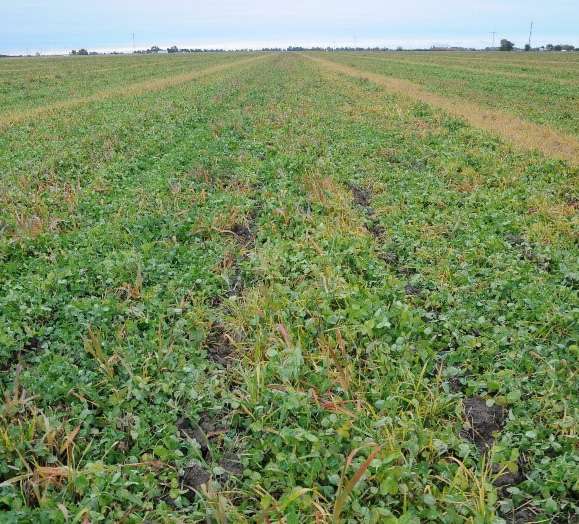
• Evaluation of a clover stand—The goal is a uniform stand of at least 3–4 plants per square foot. Clover stands may seem to disappear under hot, dry conditions immediately
before small-grain harvest but will ofen recover within 1–2 weeks. Fall Work
• Manure—Manure can be applied at low rates on the surface, immediately afer hay harvest, or by using low-disturbance injectors to minimize damage to the clover stand.
• Termination—For producers new to this rotation, fall termination of medium red clover prior to a hard frost is recommended. At this stage, plants are actively translocating carbohydrates to the root system, which improves the movement of systemic herbicides throughout the plant and reduces the risk of spring regrowth. Efective herbicide programs for terminating red clover in the fall include:
– Glyphosate (1.1 to 1.5 lb. a.e./A) + 2,4-D ester (1.0 lb. a.i./A)
OR
– Glyphosate (1.1 to 1.5 lb. a.e./A) + dicamba (0.5 lb. a.i./A)
OR
– 2,4-D ester (0.5 lb. a.i./A) + dicamba (0.5 lb. a.i./A)
(See also Using Red Clover as a Cover Crop in Wheat in Resources.)
If herbicide termination is not an option, mechanical termination is possible, though it may require multiple passes. A light chisel-plow pass followed by another may be needed, depending on soil type and stand density.
Even with a fall termination of red clover, signifcant residue may persist if the winter was dry or the stand had signifcant biomass. Assess your situation and consider the following:
• Corn planting—Check planting depth and seed furrow closure shortly afer beginning to plant into the cover crop residue as adjustments are ofen needed.
• Insecticidal seed treatments or insecticides applied at planting—Incorporating clover residue before planting corn increases the risk of seed corn maggot damage. To reduce this risk, you may consider using a seed-applied or in-furrow insecticide and/or wait at least two weeks after incorporating residue before planting corn.
• Scouting—After planting, scout for corn emergence, stand, and insect pests as well as for red clover escapes and weeds. Cover crop residue can delay weed emergence, delaying the timing of postemergence herbicide applications.
• Fertility and liming—Legume cover crops can be a source of nitrogen (N) because they fx atmospheric nitrogen through root bacteria. Afer termination, soil microbes release this nitrogen as they decompose the plant material. Thanks to their low carbon-to-nitrogen ratio, legumes return nitrogen to the soil faster than grass cover crops. The N credit will vary depending on red clover biomass and termination timing, ranging from about 10–70 lbs. N/acre. (See Nitrogen Credits from Red Clover as a Cover Crop between Small Grains and Corn in Resources.)
Resources
University of Minnesota Extension Cover Crops website, z.umn.edu/cover-crops
Cover Crop Selector Tools, http://mccc.msu.edu/selector-tool/
USDA–Risk Management Agency Cover Crops website, https://www.rma.usda.gov/Topics/Cover-Crops
North Dakota Weed Control Guide (North Dakota State University Extension), https://www.ndsu.edu/agriculture/extension/publications/north-dakota-weed-control-guide
Managing Risk When Using Herbicides and Cover Crops in Corn and Soybean (University of Minnesota Extension), https://z.umn.edu/UMNherbicidescovercrops
Intercropping Winter Cereal Grains and Red Clover (Iowa State University Extension PM 2025), https://www.midwestcovercrops.org/wp-content/uploads/2018/12/IA_2006_Intercropping-Winter-Cereal-Grains-and-Red-Clover.pdf
Cover Crop Seeding Guide (Minnesota Agronomy Technical Note 33)—available from the USDA–Natural Resources Conservation Service), https://efotg.sc.egov.usda.gov/references/public/MN/340_MN_GD_Agronomy_Technical_Note_2024.pdf
The Small Grains Field Guide (University of Minnesota Extension), z.umn.edu/SmallGrainsFieldGuide
Using Red Clover as a Cover Crop in Wheat (Michigan State University Extension), https://www.canr.msu.edu/uploads/fles/AABI/Red_clover_in_wheat_2011_HudsonEtAl_MSU.pdf
Nitrogen Credits from Red Clover as a Cover Crop between Small Grains and Corn (Cornell University Extension, Agronomy Fact Sheet 60), http://nmsp.cals.cornell.edu/publications/factsheets/factsheet60.pdf
Authors
Mary Nesberg, University of Minnesota Extension, and Lizabeth Stahl, University of Minnesota Extension (Note: This publication was adapted with consent from MCCC under a joint project to produce customized introductory guidance about cover crops for all member states/provinces.)
Reviewers and Contributors
Anna Cates, University of Minnesota Extension, Midwest Cover Crops Council; Claire LaCanne, University of Minnesota Extension, Midwest Cover Crops Council; Martin Larsen, farmer, Olmsted County (MN) Soil and Water Conservation District; Matt Leavitt, University of Minnesota—Forever Green Initiative; Anna Morrow, Midwest Cover Crops Council; Theresa Pedretti, Conservation Technology Information Center; Jochum Wiersma, University of Minnesota Extension; and Tarah Young, University of Minnesota Extension