Articles posted by Anna Morrow

Midwest Cover Crops Council (MCCC-126)


This publication is intended to provide a starting point for farmers who are new to growing cover crops. With experience, farmers may fine-tune the use of cover crops for their systems.

Introduction

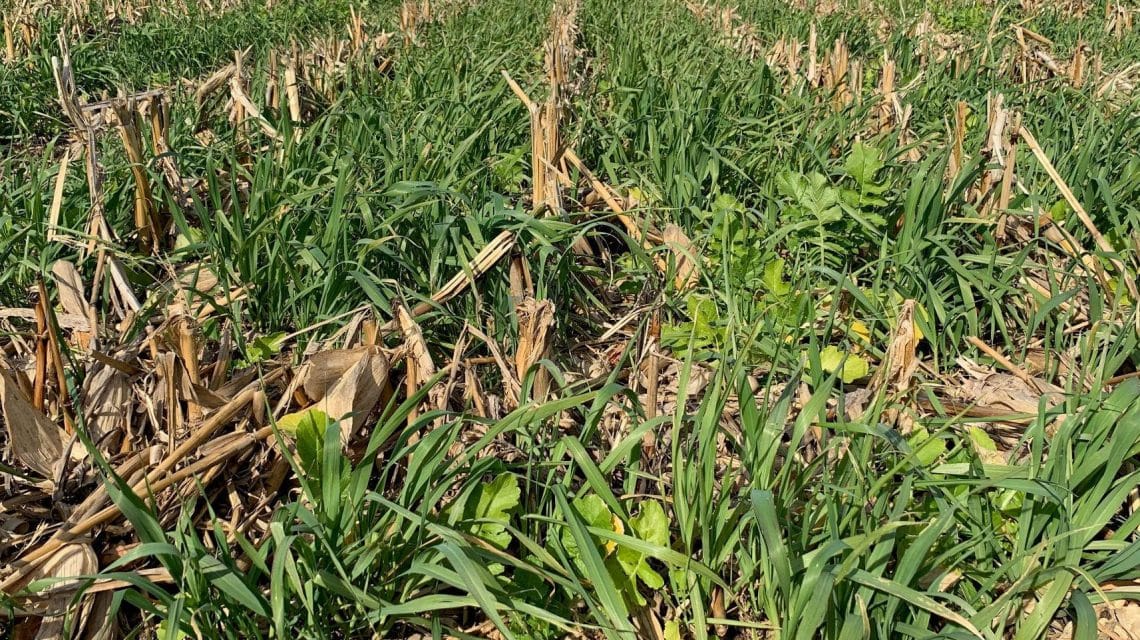
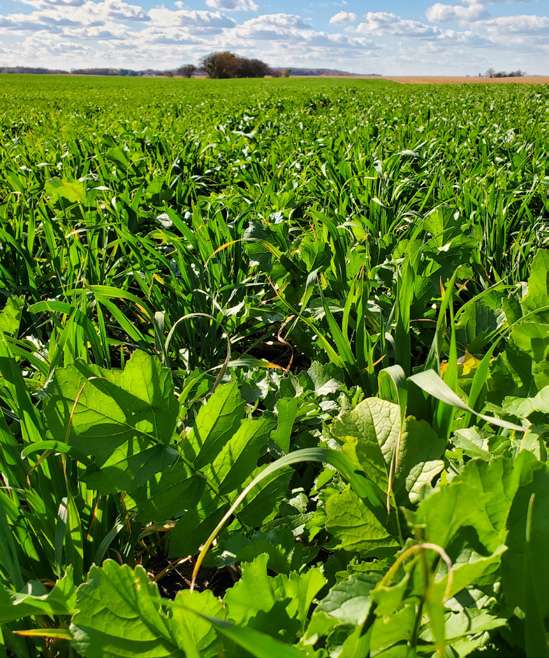
A canning or processing crop such as green bean, sweet corn, or pea is harvested early or by midsummer and offers an excellent window to get adequate cover crop growth before any following crop. Cover crops following canning crops will protect soil from erosion and improve soil structure after heavy harvesting equipment is used to take off the canning crop. Some canning crops leave significant residual nitrogen (N) in the soil that is vulnerable to leaching, and a cover crop can retain that soil N for future crops. Since growers follow canning crops with any number of different rotations, a fast-growing species such as oats mixed with a light seeding of radish is a safe choice as both will winter-kill. With this combination, no spring termination is needed, and there is little chance of tying up N for the following year.
Planning and Preparation
  • Planning—Educate yourself. Go to field days, learn from farmers who are currently planting cover crops, read about cover crops, check out cover crop research results from local universities, and work with your local Natural Resources Conservation Service (NRCS) and Soil and Water Conservation District (SWCD). Identify your goals in planting a cover crop as these will drive many decisions. Start small, and choose a field that has low weed pressure to create the best conditions for success. Consult with your crop insurance representative to ensure planned practices will not affect your insurance coverage.
  • Canning crop management—Follow best management practices regarding fertility and weed management, and make sure to notify the canning company that you’re planning on a cover crop after a canning crop harvest.
  • Residual herbicides—Commonly used herbicides can negatively impact cover crop establishment, so check the history of herbicide application for your field. Oats can tolerate many preemergence and postemergence herbicides. However, if the oats/radish biomass is to be grazed or used for feed or forage, you must follow the rotational crop restrictions listed on the label of any applied herbicides. Rotational restrictions should be checked for herbicides used in the current and previous cropping season if the cover crop is to be grazed or used for feed or forage. (See Using Herbicides and Cover Crops in Corn and Soybean in Resources.)
  • Seed purchase—Order cover crop seed early from a reputable source. If you grow your own, get it tested for germination, purity, and weed seed. Named varieties can produce more growth and have more predictable development, but they are usually more expensive than VNS (variety not stated) seed. Use good quality seed that has been cleaned and tested for germination and weed seed contamination. Utilize local sources of seed as much as possible to help prevent the introduction of invasive noxious weeds such as Palmer amaranth.
  • Fertility or manure—Fall fertilizer incorporation could damage the cover crop and destroy any structure gained, so plan to apply any needed fertility after the cover crop has winter-killed. If manure will be applied in the fall, use low-disturbance injectors to minimize damage to the cover crop.
Summer/Fall Field Work
  • Timing of cover crop planting—After canning crop harvest, some light tillage may be necessary to create a seedbed for the cover crop. Using a leveling tool such as a vertical tillage bar with an air seeder on top allows for tilling and seeding the cover crop at the same time. Try to time seeding when rain is in the forecast, or if you use irrigation, you can water in the seed for reliable establishment.
  • Planting method—Drill the seed to a depth of 0.75 inch, or broadcast the seed with a shallow incorporation to less than 1 inch to allow for good seed-to-soil contact and enhanced establishment.
  • Seeding rate—For oats, a minimum seeding rate of 21 lbs./acre of pure live seed (PLS) is suggested when seed is drilled or incorporated. The seeding rate should be increased to a minimum of 45 lbs./acre of PLS if broadcast. For radish, the rate is 1.2 lbs./acre if drilled or incorporated, and 1.7 lbs./acre if broadcast. These rates are based on a mixture of 70% oats–30% radish. If another ratio is desired, rates should be adjusted using the Minnesota Cover Crop Design Tool (see Resources).
  • Tillage—No fall tillage is needed. The oat/radish residue will freeze, then decompose over the winter, and a cash crop such as field corn or soybeans can be no-tilled into the residue if you wish. While full-width tillage may be used in the spring, this will reduce soil structural improvements the cover crop provided over the winter.
  • Future considerations—An oat/radish mixture is promoted here as the entry-level cover crop mixture post-canning crop. In future years, you may consider grasses that survive the winter (e.g., winter rye or triticale) for spring erosion control or legumes (e.g., crimson clover, which winter-kills, or red clover, which survives the winter) to supply N to the next cash crop. However, both of these options will have separate considerations and management recommendations. Use the Cover Crop Selector Tool (see Resources), or visit with local representatives of NRCS or Extension for more specific information on seeding other species.
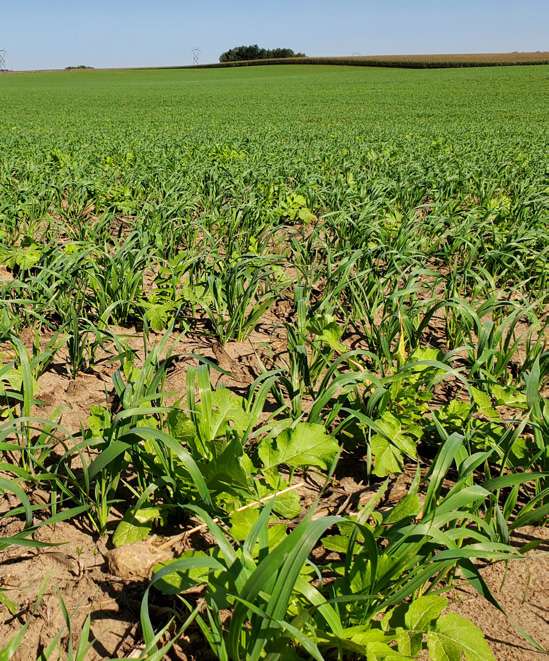
Figures 1 and 2: An oat-radish mixture planted Aug. 25 in Dakota County, MN, pictured on Sept. 24 (top) and on Oct. 14 (bottom). (Ashley Gallagher, Dakota SWCD)
Spring Work
  • Scouting—In the spring, scout the remaining cover crop residue, and note whether any oat seed that remained dormant over the winter begins to sprout in the spring. Any grass-target herbicide should take care of these escapes.
  • Cash crop planting—Most modern row planters are fully capable of planting corn or soybeans into residue from a dead oat/radish cover crop. Row cleaner attachments may be beneficial. Check planting depth and seed furrow closure shortly after beginning to plant in case any planter adjustments are needed, such as increasing down pressure to move through increased residue.
  • Scouting after planting—After planting, scout for emergence and population as well any insect, disease, or weed pressure.
Resources

University of Minnesota Extension Cover Crop website

Cover Crop Selector Tool —available from Midwest Cover Crops Council

Minnesota NRCS Resources, including Minnesota Cover Crop Design Tool

USDA-NRCS Cover Crop Termination Guidelines

Using Herbicides and Cover Crops in Corn and Soybean (University of Minnesota Extension)

Authors

Anna Cates, University of Minnesota Extension; Ashley Gallagher, Dakota Soil and Water Conservation District (Minnesota); Steve Lawler, Mower Soil and Water Conservation District (Minnesota); and Matt Ruark, University of Wisconsin–Madison Division of Extension

Reviewers and Contributors

Carl Rosen, University of Minnesota; Ken Schroeder and Dan Smith, University of Wisconsin–Madison Division of Extension; and Carissa Spencer, Minnesota NRCS

The Midwest Cover Crops Council (www.https://www.midwestcovercrops.org) aims to facilitate widespread adoption of cover crops throughout the Midwest by providing educational/outreach resources and programs, conducting new research, and communicating about cover crops to the public.
Funding for this project was provided by McKnight Foundation.

March 2021

The U.S. Department of Agriculture (USDA) prohibits discrimination in all its programs and activities on the basis of race, color, national origin, age, disability, and where applicable, sex, marital status, familial status, parental status, religion, sexual orientation, genetic information, political beliefs, reprisal, or because all or a part of an individual’s income is derived from any public assistance program. (Not all prohibited bases apply to all programs.) Persons with disabilities who require alternative means for communication of program information (Braille, large print, audiotape, etc.) should contact USDA’s TARGET Center at (202) 720-2600 (voice and TDD). To file a complaint of discrimination write to USDA, Director, Office of Civil Rights, 1400 Independence Avenue, S.W., Washington, D.C. 20250-9410 or call (800) 795-3272 (voice) or (202) 720-6382 (TDD). USDA is an equal opportunity provider and employer. ©2021 by MCCC. All rights reserved.

Share

Midwest Cover Crops Council (MCCC-125)

University of Guelph (SAG-FS-20-001)


This publication is intended to provide a starting point for farmers who are new to growing cover crops. With experience, farmers may fine-tune the use of cover crops for their systems.

Introduction

The following recipe provides an introductory approach to integrating a cover crop after corn silage harvest and before planting soybean as the next crop.

Planning and Preparation
  • Planning—Read about cover crops. Go to field days. Start small. Be timely. Prioritize management based on purpose and objectives.
  • Residual corn herbicides—Read the product label to identify any recropping restrictions for planting fall rye (Secale cereale L.) after silage corn harvest. Rye should not be grazed or harvested for forage unless product labels explicitly permit the use of an underseeded, treated crop as feed or the recropping restrictions are followed. (See Table 4-4, Herbicide Crop Rotation and Soil pH Restrictions—Field Crops, in Publication 75A, Guide to Weed Control: Field Crops in Resources.)
  • Seed purchase—Order rye seed early, usually by early summer. Use good quality seed from a reputable seed dealer. Bin-run seed doesn’t have guaranteed germination and may come with unwanted weed seeds. Consider doing a germination test before planting and adjust seeding rates accordingly.

Fall Work

  • Fall manure—It generally works best to plant cover crops following manure application via injection or surface application and incorporation. Nevertheless, so long as soil conditions are fit, manure can be applied by dragline or tanker once rye has passed the 2-3 leaf stage. This is not likely to damage the rye since the growing point remains below the ground in the fall.
  • Tillage or no-tillage—Generally, it is easier to integrate cover crops into no-tillage or strip-tillage systems. If tillage is necessary to incorporate manure or smooth the seedbed after corn silage harvest, it should take place prior to rye seeding.
  • Timing of planting—Plant rye as soon as possible after silage corn harvest and at least two weeks before the average hard frost date (-2°C). If planting later than mid-October, double the seeding rate.
  • Seeding rate—Seed at a rate of 40–90 lbs/acre (assuming a germination rate of 85% or greater). Seeding rates should be increased by 50% if broadcasting and incorporating or be doubled if just broadcasting. If the rye will be grazed or harvested as a silage crop in the spring, use a rate of 100–170 lbs/acre.
  • Planting method—Drill to a depth of 1–1.5 inches or broadcast with shallow incorporation to less than 1.5 inches. Aerial or other broadcast seeding is an option for earlier establishment into standing corn with some risk of poor or inconsistent establishment. Overly wet or dry conditions after aerial seeding or presence of slugs will limit success.
  • Other fall operations—Use a current soil test (no older than four years) to determine lime or nutrient requirements for next year’s crop. If needed, thoroughly incorporate before seeding the rye cover crop.
Rye on May 2, 2019, drilled the previous fall after corn silage at the Elora Crops Research Station (Jake Munroe)
Spring Work
  • Termination timing—Terminate the rye in the spring when plants are 6 to 12 inches tall and actively growing or about two weeks before planting soybeans—whichever comes first. In a wet or windy spring, be ready to take advantage of any break in the weather and/or use low axle weight sprayers.
  • Termination herbicide—Rye can be terminated with glyphosate after the rye begins growing in the spring (see Publication 75A, Guide to Weed Control: Field Crops in Resources). Effectiveness and speed of termination improves if rye is rapidly growing and air temperatures are warmer (>15°C). Larger rye, rye past the boot stage, or rye sprayed during cooler weather can be more difficult to kill, may require higher glyphosate rates, and will die more slowly.
  • Option to harvest rye as a silage crop—Some growers may be interested in harvesting rye as an additional silage crop. Make sure all herbicide restrictions are followed. Also, this will typically delay the planting date for the next crop, but any fall-applied nutrients can be counted toward the rye crop in nutrient management planning. (See Resources for additional information on rye forage management.) Be sure to control rye regrowth.
  • Soybean planting—Almost all modern planters and drills, with some modifications, are capable of planting soybean into a rye cover crop. Check that soybean seed is planted into moisture and the slot is closed shortly after beginning to plant; usually some adjustments are needed.
  • Scouting—After planting, scout for soybean emergence, stand establishment, and weed control. Rye residue can delay annual weed emergence, which may shift the timing of post-emergence herbicides.
Resources

Cover Crop Selector Tool —available from Midwest Cover Crops Council

Publication 811, Agronomy Guide for Field Crops (OMAFRA)

Publication 75A, Guide to Weed Control: Field Crops (OMAFRA)

Cover Crops (OMAFRA web publication)

Double Cropping Fall Rye for Extra Forage (OMAFRA web publication)

Get a Jump on Early Spring Forage (OMAFRA web publication)

Authors

Cameron Ogilvie, University of Guelph; Jake Munroe, OMAFRA; Mike Cowbrough, OMAFRA; Christine O’Reilly, OMAFRA; Laura Van Eerd, University of Guelph; Anne Verhallen, OMAFRA

Reviewers and Contributors

Dale Cowan, AGRIS Co-operative Ltd.; David Hooker, University of Guelph; Peter Johnson, Real Agriculture; Darren Robinson, University of Guelph; Peter Sikkema, University of Guelph; and François Tardif, University of Guelph

The Midwest Cover Crops Council (www.https://www.midwestcovercrops.org) aims to facilitate widespread adoption of cover crops throughout the U.S. Midwest and Ontario by providing educational/outreach resources and programs, conducting new research, and communicating about cover crops to the public.
Funding for this project was provided by McKnight Foundation.

August 2020

The U.S. Department of Agriculture (USDA) prohibits discrimination in all its programs and activities on the basis of race, color, national origin, age, disability, and where applicable, sex, marital status, familial status, parental status, religion, sexual orientation, genetic information, political beliefs, reprisal, or because all or a part of an individual’s income is derived from any public assistance program. (Not all prohibited bases apply to all programs.) Persons with disabilities who require alternative means for communication of program information (Braille, large print, audiotape, etc.) should contact USDA’s TARGET Center at (202) 720-2600 (voice and TDD). To file a complaint of discrimination write to USDA, Director, Office of Civil Rights, 1400 Independence Avenue, S.W., Washington, D.C. 20250-9410 or call (800) 795-3272 (voice) or (202) 720-6382 (TDD). USDA is an equal opportunity provider and employer. ©2020 by MCCC. All rights reserved.

Share

Subscribe to our ListServ

Sign up to receive the latest MCCC news and updates!