Claire Strader, Julie Dawson, Heidi Johnson – University of Wisconsin
Living Mulch under Organic Acorn Squash and Brussels Sprouts
Source link here.
Claire Strader, Julie Dawson, Heidi Johnson – University of Wisconsin
Living Mulch under Organic Acorn Squash and Brussels Sprouts
Source link here.
Erin Silva – University of Wisconsin
June 2017
YouTube Video: Using the roller-crimper system with early planted emerged organic soybean
May 2017
Considerations for Cover Crop Interseeding
Source link here.
2017 MCCC Annual Conference Presentation – Forage/Grazing Track
Kevin Shelley, University of Wisconsin and Brandon Gibson, Michigan Farmer
March 2017
2017 MCCC Annual Conference Presentation – Vegetable Crops Track
Dan Brainard, Ben Werling – Michigan State University and Ralph Oomen, Michigan Farmer
March 2017
Mustard family cover crops for crop establishment and pest management in vegetables
2017 MCCC Annual Conference Presentation – Vegetable Crops Track
Ben Phillips, Michigan State University Extension and Mike Yancho Jr., Farmer
March 2017
I can’t believe it’s not butternut on plastic! Year two rye cover and fertility observations
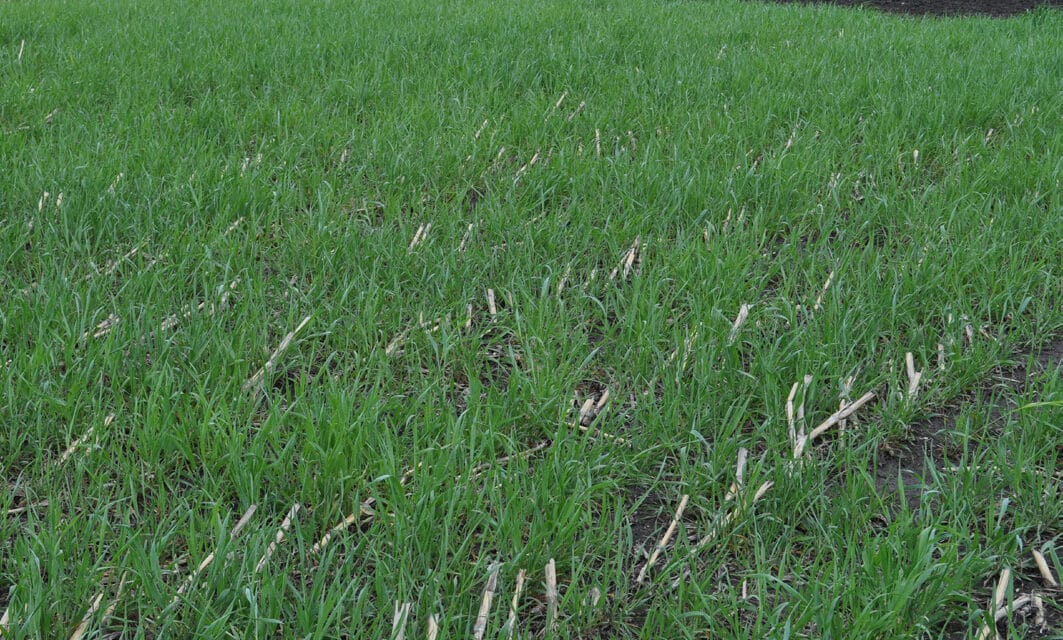
In partnership with twelve farmers across the state, Iowa Learning Farms and the Iowa Cover Crop Working Group are conducting the longest running on-farm cover crop research and demonstration project in the state of Iowa. Established in 2008 and 2009, these on-farm sites include randomized, replicated strips with and without cereal rye cover crops, all managed within corn/soybean cropping systems. Data collected included above-ground cover crop biomass near the time of spring termination, crop yield, soil health measurements, and earthworm midden counts. Key project findings to date:
Rye Cover Crop Project Webpage
Earthworm Midden Project – Blog Post and November 2016 Webinar Link
Additional Cover Crop Resources from Iowa Learning Farms
Presented at the 2017 Soil Health Conference in Ames, IA.
Full poster: Exploring Soil Health and Agronomic Impacts of Cover Crops: On Farm Results
Iowa Learning Farms and Practical Farmers of Iowa
Winter Cereal Rye Cover Crop Effect on Cash Crop Yield; Year 8 January 2017
Winter Cereal Rye Cover Crop Effect on Cash Crop Yield; Year 7 July 2016
Winter Cereal Rye Cover Crop Effect on Cash Crop Yield; Year 6 July 2016
Winter Cereal Rye Cover Crop Effect on Cash Crop Yield; Year 5 March 2014
Source link: Iowa Learning Farms.
Camelina is an annual oilseed crop in the Brassicaceae family that has been cultivated since 4000 BCE. Recently, interest in its oil, meal and the developed products has increased research in this crop. This renewed interest is evidenced by the tremendous increase in peer-reviewed publications containing the word ‘camelina’. Databases report 335 publications between 2013 and 2016, with 149 of those published since 2015. The objective of this review was to compile and summarize new and existing information in order to identify gaps in knowledge and areas for future research. This review includes the most recent publications in camelina description and origin, uses, genetics, genomics, breeding, molecular genetics, physiology, agronomic management, and ecosystem services. Although the breadth of research in camelina over the last few years is impressive, several areas that would benefit from further research were identified. The development of new uses and the refinement of existing uses from camelina oil and meal will continue to add value to this crop. Advances in genetics, breeding, and genomics will speed up the development of high yielding camelina cultivars, with improved seed quality as well as disease and insect resistance. Understanding and improving freezing tolerance in camelina will advance the use of winter camelina as a cover crop or cash cover crop in double and relay cropping systems. Better management practices and weed control alternatives will be needed to increase camelina production worldwide. Lastly, commercial development of camelina will add one more crop to the already low agricultural diversity in many parts of the world.
Article Citation: Marisol Berti, Russ Gesch, Christina Eynck, James Anderson, Steven Cermak, Camelina uses, genetics, genomics, production, and management, Industrial Crops and Products, Volume 94, 30 December 2016, Pages 690-710, ISSN 0926-6690, http://dx.doi.org/10.1016/j.indcrop.2016.09.034.
Science direct article here.
Daren Redfearn and Bruce Anderson – University of Nebraska
December 2016
Is Nitrogen Fixation Oversold with Legume Cover Crops?
Source link here.